

Inclusive Education: Assuring Enhanced Learning, Appropriate Evaluation
- Par Kimeng Hilton
- 21 Oct 2025 15:20
- 0 Likes
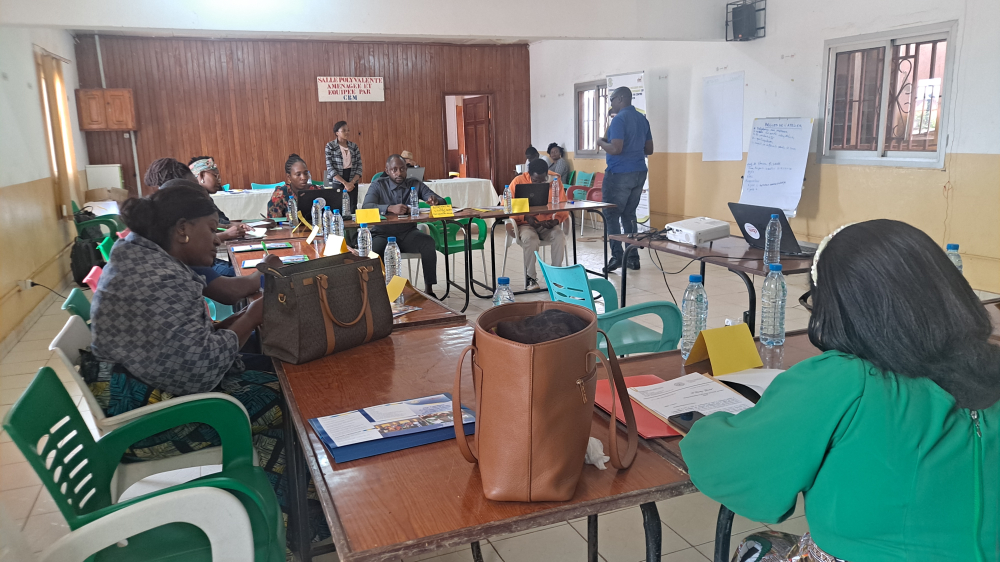
PROMHANDICAM Association has organized a number of training sessions for teachers of children with disability in the Centre Region.
“Children with special needs - no matter their disability - face many challenges in school. They do not often have the opportunity to receive their lessons in a manner as to facilitate understanding like able-bodied children. This is because many teachers do not have the requisite skills to teach them. For example, a mathematics lesson with drawings or tables is of no major problem to children with no visual impairment.
Easing Access
But for those with this challenge, the teacher must look for an alternative way of teaching the same lesson so that all the children at the end have the same understanding,” said Mr. Michel Fozeu, Officer in charge of Advocacy with PROMHANDICAM Association. He spoke in Yaounde on October 21, 2025 at the opening of a second workshop as part of the project, “Strengthening access to inclusive education and economic empowerment of persons with disabilities in the Centre Region of Cameroon.” The two-day workshop comes after the first from October 15-16, 2025. Respectively meant for nursery, secondary and teacher training college teachers.
With Their Needs In Mind
“In the same light, if examination questions do not take into consideration the different deficiencies of learners, the children will not do well. The workshop seeks to acquaint teachers with learning methods adapted to learners with visual impairment and those with other disabilities. Lessons and examinations must be inclusive - taking into account learners with hearing, seeing, understanding, writing…. challenges,” Fozeu pointed out.
Better Methodology
The facilitator of the workshop, Mr. Gabriel Foyang, insisted that the different forms of disability students must be carefully taken into consideration in evaluating them. While Mrs. Nanga Babeth Rosine, a German language teacher with Government High School, Soa, said until now, she and her colleagues barely managed to teach children with disability because they did not know the techniques. Neither did they know how to refer to them or understand inclusive language to make these students feel at ease.
“Since four years, we have been receiving children living with disability. For now, our school has about 12 such students. I will go back and train my colleagues in the skills I will acquire from the workshop for us all to begin to put into practice inclusive education in Government High School, Soa,” Mrs. Nanga pledged.
Economic Improvement
The project, “Strengthening access to inclusive education and economic empowerment of persons with disabilities in the Centre Region of Cameroon” has as specific objective to improve access to education, economic opportunities and social participation for persons with disabilities in the Centre Region of Cameroon. The overall project objective is to contribute to improving the quality of life of persons with disabilities in the Centre Region of Cameroon.
Project Targets
The project targets 15 secondary schools (600 teachers), two public universities (the Universities of Yaounde I and II), four general education teacher training colleges (ENIEGs), two technical education teacher training colleges (ENIETs) and families of persons with disabilities.
Expected to benefit from the project are 3,000 persons with disabilities (2,500 children and 500 adults); 60 organisations of persons with disabilities; 15 support groups for parents of children with disabilities; and 100 nursery and primary schools (1,200 teachers and 15 educational facilitators). The project seeks to improve access to quality inclusive education in an accessible and safe environment for all; and to ease access to socio-economic opportunities for persons with disabilities.
1 Billion Persons With Disability
According to the World Health Organisation, WHO, approximately 16 percentage of the world's population lives with a disability (nearly one billion people.) In Africa, rates vary between 2 per cent and 16 per cent, depending on the country. Among these disabilities, visual impairment is of particular concern. Some 1.2 per cent of the total African population has a visual impairment, with an estimated prevalence of 5.4 per cent in Cameroon (MICS 2011). These figures highlight the urgent need to take specific measures to ensure the inclusion of people living with disabilities in all aspects of life, particularly education.
...
Cet article complet est réservé aux abonnés
Déjà abonné ? Identifiez-vous >
Accédez en illimité à Cameroon Tribune Digital à partir de 26250 FCFA
Je M'abonne1 minute suffit pour vous abonner à Cameroon Tribune Digital !
- Votre numéro spécial cameroon-tribune en version numérique
- Des encarts
- Des appels d'offres exclusives
- D'avant-première (accès 24h avant la publication)
- Des éditions consultables sur tous supports (smartphone, tablettes, PC)




Commentaires