
US Embassy In Cameroon : H.E. Christopher Lamora Bids Bye
- Par Eldickson Agbortogo
- 05 Jan 2026 15:26
- 0 Likes
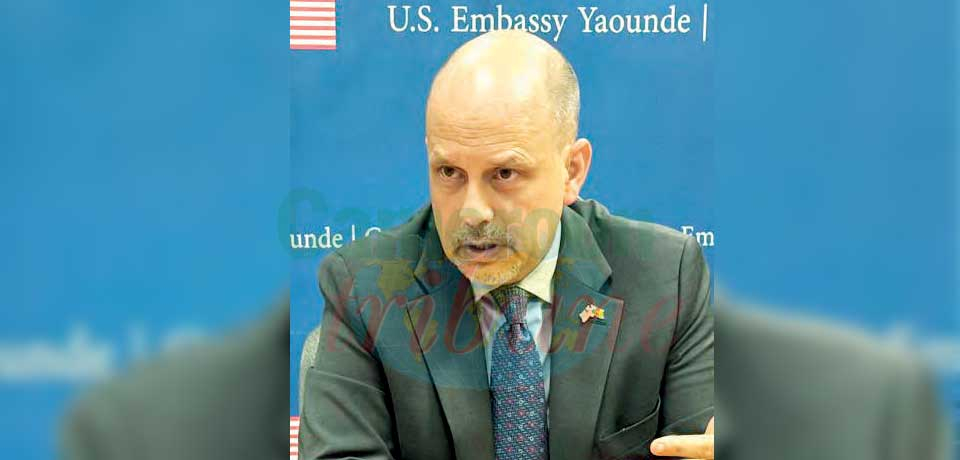
After four years of diplomatic services, the United States Am- bassador to Cameroon His Excellency Christopher Lamora, will in a few days jet back home to the United States. During his stay in Cameroon, Ambassador Lamaro did not only cir- cumnavigate the entire nation to get first-hand information on the political climate, economic development, health and security issues, but also contributed enormously to see that some of the issues are either solved or are on the right track. Among his numerous souvenirs, is the recently signed transformative 900-million-dollar agreement, to help develop the public health sector in Cameroon up to 2031. In a chat with the press at the US Embassy in Yaounde last Tuesday, the seasoned diplomat scanned through his four-year stay in Cameroon.
What is the state of relations bet- ween Cameroon and the United States?
The relationship between the United States and Cameroon is strong and positive, and the government aspect is part of it. But it is not the be all and end all of that. The relationship is good between US and Cameroonian businesses, US and Cameroonian institutions, US and Cameroonian academic institutions, US and Cameroonian people and almost all our component parts of the overall positive relationship. I think bilateral relationship is very good. Some may remember the headline of Cameroon Tribune newspaper in December of 2022, after I had been here for nine months, President Paul Biya went to participate in the US-African Leaders Summit that was hosted by then President Joe Biden. I will never forget the headline that was in French, “Calm after the storm”. Because there was a recognition on both sides that the relationship had for a number of years been tense. I do not take personal credit for this, it was the whole embassy, all of US government effort, together with the Cameroon government to get us from a place of tension to the “Calm after the storm”. That was three years ago that the headline appeared in Cameroon Tribune newspaper. I think that we have very much continued and built on that track.
After building on that track for four years, what balance sheet can you make of your stay in Cameroon?
First of all, I don't want to take the credit, nor pat myself on the back for the successes we've had over the past four years. It's the whole embassy team. If I talk about security cooperation, for example, it's the defense attaché, it's the office of security and military co- operation, that has conducted training with Cameroonian forces, the BIR and others. There are Cameroonians who have gone to the United States to study in our military academies. That's part of the Department of Defense, now the Department of War. If we talk about in- tercultural relations, education, it's the Public Affairs section and public diplomacy that handle exchanges. We have had hundreds, if not thousands of Cameroonians, who have gone to the United States over the past four years for training, as well as thousands who have been able to do so here in Cameroon, either in the embassy library, or in our three branches in Douala, Buea, and Garoua, where we have small libraries. For public health cooperation, we have just signed a transformative agreement of almost 900 million US dollars for the next five years, which will develop the public health system in Cameroon up to 2030-2031. And this is based on all the public health cooperation we have had over decades. So in health, security, and human relations, there are many things we have done, and I am proud of them.
You may be meeting President Paul Biya for a farewell audience. During the audience, what are some of the key issues you'll be discussing with him?
Well, I think there are a couple of things that I would like to see improve in Ca- meroon. I've been affiliated with this country on and off for almost 35 years, I know there are things that can be better. But my fundamental message to the President would be that the United States and Cameroon remain close partners in a variety of areas. There is almost $900 million public health agreement we just signed a few weeks ago. In security, we had the head of AFRICOM, US-Africa in September that has been long standing and is continuing. Cameroon has been a good partner in coun- terterrorism and maritime security. On the humanitarian front, Cameron has been a very welcoming country for hundreds of thousands of refugees from neighboring countries. We want to see more U.S. investments in Cameroon. I will talk to him on how we can work to improve the business climate. We need to make the business climate here such that American companies that want to trade, invest, create jobs for the millions of Cameroonians who are underemployed or unemployed do benefit from these opportunities. There are areas like security, health, economics and trade where we can and we have worked together. I would expect that to continue under whoever succeeds me.
You mentioned earlier the business environment. What is your vision?
I would very much love to see US businesses coming to Cameroon. Investing in Cameroon, developing trade relationships with Cameroon. I would love to see more corporate partnerships, joint ventures between US and Cameroonian companies. I think it's good for both countries. It gets jobs in the United States, it supports US manufacturing, depending on the kind of goods we are talking about. Which is very much a priority of President Trump. If you look at the newly issued national security strategy of about 27 or 28 pages, that came out in November 2025, the commercial and economic aspect of US foreign relations is front and centre. It's good for the United States, good for the US economy, but it's good for the Cameroonian economy as well. It creates jobs. If you get a major American company that comes here and invests, builds a factory, has a joint venture, that is going to provide many jobs for Cameroonians. We know that Cameroonians need to be better employed. However, the business environment here is not always conducive to the kind of trade and development relationships that both countries would like to see. So I would like the business climate here to improve in order to encourage foreign investments.
Why do you think the business environment is not so conducive?
I think it is in terms of investor confidence. It's in terms of independence of the judiciary, in the sense that if I am an American investor and I get into a dispute either with the government or with a Cameroonian partner, I believe I'm going to get a fair hearing. I think you only have to look at the absence of US investors here, you wonder why they're not coming. We have a publicly facing statement that we have put out there that talks about it in very clear terms, the challenges U.S. companies face.
After the October 2025 presidential election your embassy issued a communique congratulating the President on his swearing-in and not on his reelection which attracted various interpretations. Can you clarify your government's position?
There's nothing to clarify. It was clear. We congratulated the President on being inaugurated for his new term of office. With regard to the election itself, it is the policy of the Trump administration, the policy of the United States govern- ment that elections are fundamentally in the domestic purview of the country in question, and it is not the place of the United States to comment on the running of such elections or the out- come. It is for the domestic constituency of the country to sort out what they think went wrong.
What observations would you make with regards to the conduct of the election?
Cameroon and the United States are very much brotherly countries and Cameroon also has a special place in my heart. As you know, I am concerned about what happens here in general. I'm concerned about the Cameroonian people, development, economic opportunities and all of those things that I've been working for, for four years. The Cameroonian election was highly contested. We obviously had one op- position candidate who came out ahead of the pack of the opposition and we had President Paul Biya who came up very strong throughout the country. If I recall correctly, losing two Regions and coming close to losing the third for the first time in recorded memory. I think there were 12 candidates officially on the ballot, minus the two that dropped towards the end. Cameroonians went to the polls in their millions and expressed their opinion. We were plea- sed to see that kind of engagement by people in what they want the future of their country to be. That's what we saw in October 2025. With regard to what happened afterwards, I think it's important to note that, yes, it is tragic, it's 100% tragic that there was loss of lives on the part of demonstrators, and there was loss of lives on the part of security service personnel as well. Should property have been destroyed? No. Should buildings have been burned down? No. Should people have died? No. It's for Cameroon and the Cameroonian people to decide how to address the aftermath of the election. Each time you talk about the crisis in the English-speaking Regions of Cameroon, you recommend dialogue.
From your observation and conversations with different stakeholders, what is really blocking the dialogue?
Why should it be the United States, Canada, Switzerland or anybody else outside Cameroon to prescribe what the dialogue might look like? Violence of any kind, is never going to be the answer to whatever crisis. Did we see a resolution to the tensions in the af- termath of the most recent presidential election, because people took to the streets? Did we see a resolution to the crisis in the aftermath of the election, because some small percentage of those demonstrators became violent and burn buildings down? Did we see a resolution to the crisis after the election because i...
Cet article complet est réservé aux abonnés
Déjà abonné ? Identifiez-vous >
Accédez en illimité à Cameroon Tribune Digital à partir de 26250 FCFA
Je M'abonne1 minute suffit pour vous abonner à Cameroon Tribune Digital !
- Votre numéro spécial cameroon-tribune en version numérique
- Des encarts
- Des appels d'offres exclusives
- D'avant-première (accès 24h avant la publication)
- Des éditions consultables sur tous supports (smartphone, tablettes, PC)





Commentaires