
The Last Sanitation Mile: How MPROPRETÉ Is Tackling Yaounde’s Garbage Challenges
- Par Kimeng Hilton
- 12 May 2026 16:11
- 0 Likes
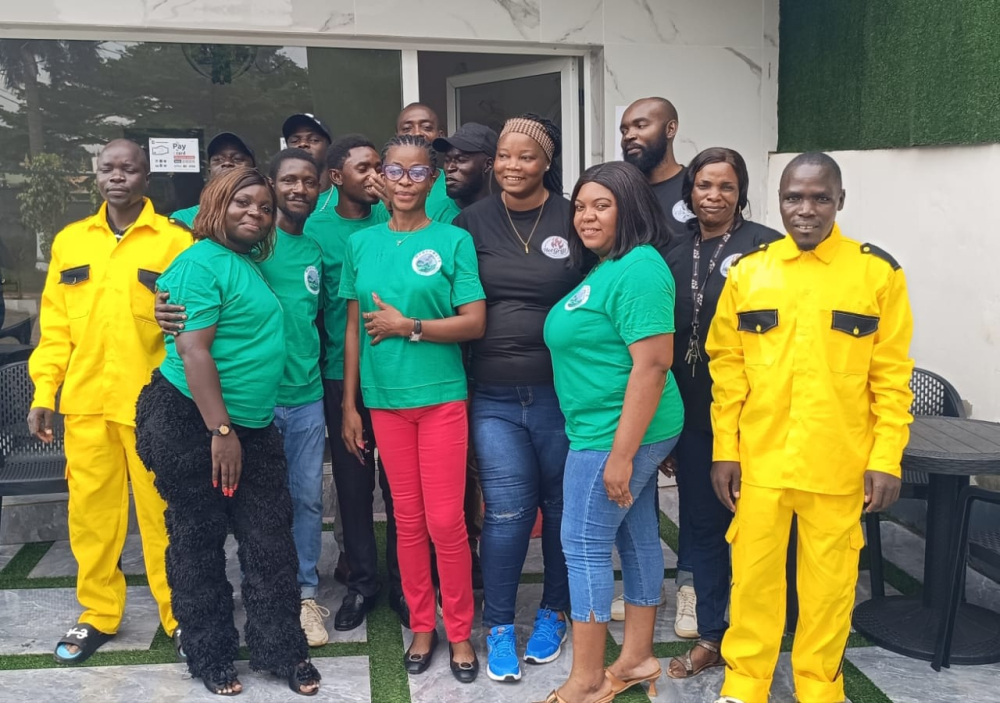
The initiative recruits local neighbourhood people to sensitize, place and collect filled refuse sacks from the homes of subscribers to dumpsters. Thereby working in tandem with the city’s major garbage collector.
The Cameroonian capital, Yaounde, "The city of seven hills," has long been synonymous with architectural grandeur and political power. However, in recent years, a more pungent reality has crept into the crevices of the capital. From the bustling markets of Mokolo to the residential arteries of Yaoundé V Subdivision, the sight of "dépôts sauvages" - illegal, sprawling garbage heaps - has become a symbol of an overstretched municipal infrastructure.
From Kitchen To The Dumpster
While the city’s primary waste management partner, HYSACAM, handles the massive task of transporting waste to landfills, a critical gap remains: the journey from the kitchen door to the communal dumpster. This "last mile" is where public health is won or lost.
Enter Alvine Mekongo, the founder of MPROPRETÉ. For five years, her organization has been quietly re-engineering the way the city breathes. By moving away from a "one-size-fits-all" model and embracing the granular reality of the terrain, Mekongo is proving that the solution to a macro-problem like urban waste lies in micro-logistics.
Crisis Of Accessibility
Yaounde’s urban planning is a study in contrasts. While neighborhoods like Bastos feature wide, paved boulevards, much of the city is composed of "quartiers enclavés" - spontaneous settlements and densely-packed neighborhoods characterized by narrow, winding alleys, steep inclines, and unpaved paths.
"We do not theorize cleanliness; we practise it daily," says Mekongo. This pragmatism is the cornerstone of her operation. Traditional garbage trucks cannot enter these enclaved zones. When the trucks can’t reach the people, they often dispose their waste in gutters, streams, or at street corners.
MPROPRETÉ’s novelty lies in its adaptability. For the "zones à accès difficile," the company has introduced reinforced trash sacks combined with a rigorous, scheduled pickup routine. This "soft" solution bypasses the need for heavy machinery, utilizing a fleet of agents who navigate the city’s arteries on foot or with light transport.
From Sacks To Bins
While the sacks solve the problem of the slums, the "accessible" zones require a different level of durability. MPROPRETÉ has deployed a range of standardized containers, from 120-liter bins for small households to massive 1,100-liter units for businesses and collective housing.
But it isn't just about providing a vessel for trash. "It is a durable solution," Mekongo explains. These bins are closed, preventing the spread of odors and the breeding of disease-carrying vectors like flies and rats. By implementing bi-weekly and tri-weekly collection schedules, the organization ensures that waste never sits long enough to become a public health hazard.
Dropped Illegal Dumping
The impact of this logistical precision is staggering. In areas served by MPROPRETÉ, illegal dumping has dropped by more than 90%. This isn't just an aesthetic improvement; it is a direct intervention in the city's epidemiology. By removing stagnant waste, the initiative is significantly reducing the incidence of waterborne diseases like cholera and typhoid, which often spike during Cameroon’s rainy seasons.
The "Green Link"
Critics of private waste initiatives often point to cost as a barrier to entry for the average Cameroonian. However, MPROPRETÉ has structured its pricing to reflect the socio-economic diversity of Yaounde. With household rates starting at 3,000 FCFA per month (roughly $5 USD), the service is positioned as an affordable utility rather than a luxury.
"Choosing MPROPRETÉ is an investment in the Cameroonian green economy," Mekongo asserts. The business model is a masterclass in local value creation. Currently employing 29 agents, the organization focuses on "non-relocable" jobs. These are local residents cleaning their own neighborhoods, creating a sense of pride and ownership that a distant municipal authority can rarely replicate.
Circular Economy
Furthermore, the initiative is the "first link" in Cameroon’s emerging circular economy. By providing the tools for sorting at the source, MPROPRETÉ is transforming "garbage" into "raw material." When plastic, organic matter, and glass are separated at the household level, they become valuable inputs for recyclers and composters, rather than just more volume for an overfilled landfill.
Partnership Of Necessity
One might expect friction between a private operator and the established giants like HYSACAM or the various City Councils. On the contrary, Mekongo views MPROPRETÉ as a "facilitator" and a "partner."
"We complement the action of the public service by taking charge of the last mile," she says. By aggregating waste from inaccessible homes and bringing it to central "points de regroupement," MPROPRETÉ makes HYSACAM’s job easier. The heavy trucks no longer have to wait for residents to run out with their bins; they simply collect from a streamlined, organized staging area. "Zero duplication, 100% efficiency," is the company's mantra.
Changing Behaviors
The hardest part of Mekongo’s job isn't the logistics; it’s the psychology. Years of inconsistent waste collection have left many citizens cynical. Changing the "reflex" from throwing a bag in a stream to placing it in a designated bin requires constant sensitization.
MPROPRETÉ’s agents double as educators. They are currently on a campaign to "vulgarize" the use of the trash sack - teaching families not just how to use them, but why. They explain the link between a clogged gutter and a flooded home; the link between a nearby dump and a sick child.
"It is about evolving behaviors," Mekongo says. The goal is to move from a culture of "out of sight, out of mind" to one of "accountability and traceability."
Scaling The Future
Currently covering the strategic districts of Yaoundé 1, 2, 5, and 7, the potential for expansion is vast. As Yaoundé continues to swell with migration and natural growth, the strain on its infrastructure will only increase.
The MPROPRETÉ model - decentralized, adaptable, and community-focused - offers a blueprint for other Cameroonian cities. It suggests that the city of the future won't be cleaned by one giant entity, but by an ecosystem of specialized partners who know their neighborhoods block by block.
Adaptation To Reality
As Alvine Mekongo walks through the streets of Bastos or the alleys of Yaoundé II, she sees more than just waste. She sees a city in transition. "We adapt to the reality of the terrain," she says. In a city as complex and vibrant as Yaoundé, that adaptability isn't just a strategy - it’s the only way to survive.
Circular Economy
Furthermore, the initiative is the "first link" in Cam...
Cet article complet est réservé aux abonnés
Déjà abonné ? Identifiez-vous >
Accédez en illimité à Cameroon Tribune Digital à partir de 26250 FCFA
Je M'abonne1 minute suffit pour vous abonner à Cameroon Tribune Digital !

- Votre numéro spécial cameroon-tribune en version numérique
- Des encarts
- Des appels d'offres exclusives
- D'avant-première (accès 24h avant la publication)
- Des éditions consultables sur tous supports (smartphone, tablettes, PC)







Commentaires