

Sustaining Lifesaving Skills: WHO, UCAC Sign MOU To Bridge Emergency Care Training
- Par Kimeng Hilton
- 28 Sep 2026 19:17
- 0 Likes
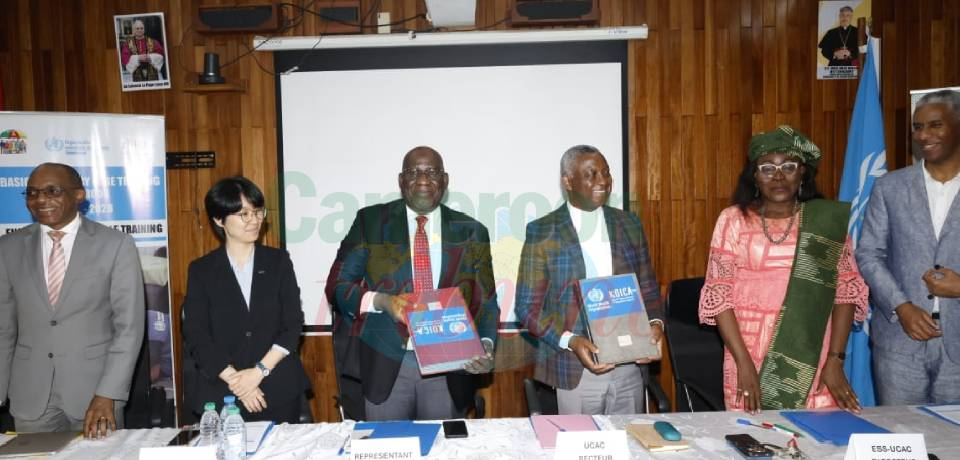
The World Health Organization and the Catholic University of Central Africa on September 28, 2026 in Yaounde signed a partnership deal.
The World Health Organization, WHO Country Office for Cameroon and the School of Health Sciences of the Catholic University of Central Africa, ESS-UCAC, signed a Memorandum of Understanding, MOU, on September 28, 2026, in Yaounde. Formally institutionalizing basic emergency medical care and community first responder training within academic curricula.
Supported By KOICA
The landmark partnership, backed by the Korea International Cooperation Agency, KOICA, seeks to address acute human resource deficits in Cameroon's health sector. And guarantee the long-term sustainability of emergency care capacity building beyond project-based interventions.
Two Training Modules
Under the framework of engagement with non-state actors, FENSA, the agreement provides for the full integration of WHO’s Basic Emergency Care, BEC and Community First Action Responder, CFAR training modules into ongoing medical and nursing degree programs at ESS-UCAC. The strategic objective is to transition emergency care instruction into a permanent, structured academic feature. Ensuring that all graduating healthcare professionals enter active service equipped with standardized, lifesaving clinical competencies.
Emergency Care Sustainability
Delivering his address during the solemn ceremony, WHO Representative for Cameroon, Dr. Bagayoko Magaran Monzon, stressed that the core ambition of the MOU is ensuring lasting sustainability. "Emergency care constitutes an essential pillar of the health system," Dr. Bagayoko stated, pointing out that healthcare workers encounter critical, life-or-death situations daily.
Ranging from cardiac arrests and severe trauma to obstetric complications - where interventions during the initial minutes determine patient survival. He emphasized that embedding emergency training into university instruction is not a luxury, but a vital necessity for the health system.
Humanizing Healthcare
Representing the Minister of Public Health, Professor Eugene Sobngwi underscored that building specialized emergency management skills directly supports the government's policy on humanizing healthcare and expanding universal health coverage. He highlighted that Central Africa faces over a hundred major emergency events annually, including natural disasters and mass population displacements. Which require robust pre-hospital and community-level responses.
Crucial Link
Noting that community health forms one of the seven primary pillars of the national health transformation agenda, Prof. Sobngwi explained that community first responders represent the crucial first link in the survival chain before facility-based interventions occur.
72,000 Active Health Workers
The institutionalization effort directly addresses stark structural challenges within Cameroon’s healthcare landscape. Presenting the country's health profile, Dr. Kouamou Boris of the WHO Cameroon Office noted that while Cameroon counts approximately 72,000 active health workers, excluding community health workers leaves a facility care density of just 20.4 personnel per 10,000 inhabitants. Less than half of the Sustainable Development Goals, SDG target threshold of 44.5 per 10,000 inhabitants.
Absent Standardized Emergency Care
Furthermore, a national assessment conducted by the Ministry of Public Health and WHO revealed a total absence of standardized ...
Cet article complet est réservé aux abonnés
Déjà abonné ? Identifiez-vous >
Accédez en illimité à Cameroon Tribune Digital à partir de 26250 FCFA
Je M'abonne1 minute suffit pour vous abonner à Cameroon Tribune Digital !

- Votre numéro spécial cameroon-tribune en version numérique
- Des encarts
- Des appels d'offres exclusives
- D'avant-première (accès 24h avant la publication)
- Des éditions consultables sur tous supports (smartphone, tablettes, PC)










Commentaires