
Science Journalism: Government Approves Yaounde As Continental Headquarters
- Par Kimeng Hilton
- 26 Nov 2026 10:46
- 0 Likes
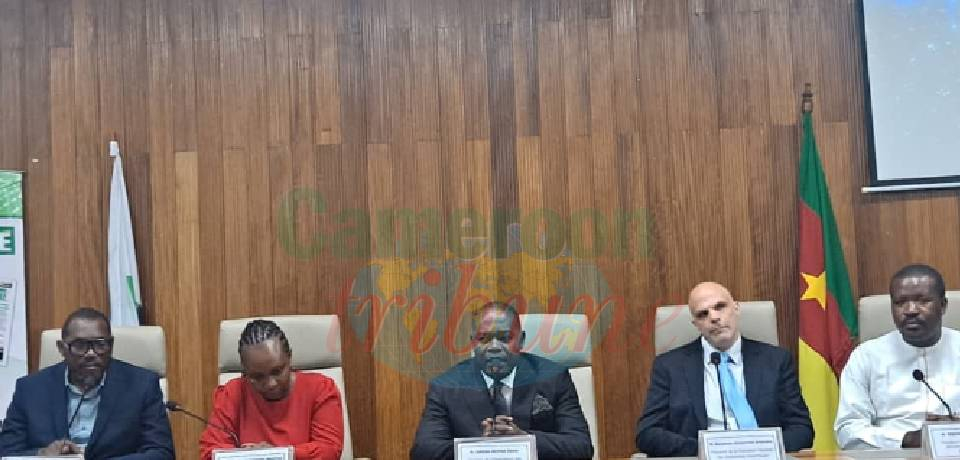
The disclosure was made in Yaounde on November 25, 2026 at a joint press conference by MINCOM and the visiting global science journalism President, Benjamin Deighton Stephen.
Leaders of global and African science journalism gathered in Cameroon’s Ministry of Communication on Wednesday, November 25, 2026, for a joint press conference, marking a major milestone for science reporting across the continent: the formal establishment of the headquarters of the African Confederation of Science Journalists in Yaoundé.
Joint Press Conference
The briefing brought together Ombga Bomba Denis, Director of Media Observatory and Public Opinion in the Ministry of Communication, representing the ministry; Benjamin Deighton Stephen, President of the World Federation of Science Journalists (WFSJ), headquartered in Montreal, Canada. Joseph Mbeng Boum, President of the African Confederation of Science Journalists; Agatha Wamaitha Ngotho, Secretary General of the African Confederation of Science Journalists; and Mamadou Traore, Deputy Secretary General of the confederation.
Science Journalism Hub
Speaking on behalf of the Minister of Communication, Ombga Bomba Denis welcomed the visiting delegation and reaffirmed government support for science journalists in Cameroon. Noting ongoing backing for activities involving Mr. Joseph Mbeng Boum as well as hosting the press conference and scheduled training sessions in the ministry. Ombga expressed hope that coverage of the visit would position Yaoundé as a hub of science journalism for Cameroon and the wider world.
Journalism And Science
Deighton Stephen underscored the stakes of science journalism in public health crises, vaccine confidence, and climate negotiations. Warning against online misinformation and noting that artificial intelligence tools draw from existing reporting. Making rigorous science journalism essential. Agatha Wamaitha Ngotho stressed that science shapes daily life and urged science journalists to deliver accurate information to communities amid social media disinformation.
Yaoundé Is Continental HQ
Tracing the trajectory of the organization, Joseph Mbeng Boum explained that efforts to create a continental body began in 2024 during the World Science Forum and the WFSJ General Assembly in Budapest, Hungary. Where leaders of African science journalism associations resolved to establish an African Confederation of Science Journalists, uniting national associations, supporting new groups, and expanding university and continuing training.
Cameroon Processes
At the confederation’s ordinary General Assembly in Pretoria, South Africa in 2025, African science journalism associations unanimously voted to locate the headquarters in Yaoundé, Cameroon. According to Mbeng Boum, administrative and diplomatic procedures followed with Cameroon’s Ministry of Communication, Ministry of External Relations, and Ministry of Territorial Administration, culminating in August 2026 with a ministerial order from the Minister of Territorial Administration - after a report and favorable opinion from the Minister of External Relations. Which authorized the establishment of the confederation’s headquarters in Yaoundé as an international organization.
African Science Journalism
Mbeng Boum said the confederation currently brings together roughly 28 member countries and is working toward opening an office in Yaoundé in the coming weeks or months. Including plans for a science laboratory for science journalism to train journalists from across Africa.
Why Choice Of Yaounde
Mamadou Traore noted that Sub-Saharan Africa has historically had fewer major media organization headquarters than North Africa. Citing the Atlantic Federation of Press Agencies, FAAPA in Rabat, Morocco and the Union of African Journalists, UAJ in Cairo, Egypt. Traore said African science journalists backed Yaoundé as headquarters because of Cameroon’s bilingual Francophone and Anglophone profile, institutional openness, and Mbeng Boum’s leadership.
Government Backing
Mbeng Boum outlined plans to work with Cameroonian authorities - including discussions initiated in the Ministry of Higher Education with the directorate overseeing programme monitoring and a planned follow-up audience with the Minister of State, Minister of Higher Education - toward operationalizing a Master’s program in Science Journalism.
Master’s Degree Plans
He noted that while many Western institutions offer Master’s or doctoral programmes in science journalism, Africa has lacked such degree programmes despite past fellowships such as SjCOOP 1 and SjCOOP 2. Which were funded by the WFSJ, and have trained about 10 Cameroonian journalists over more than a decade. And produced leading science journalism figures such as Professor Gervais Mbarga.
Cameroon, Global Host?
Speakers also pointed to longer-term ambitions, including the potential submission of a bid for Cameroon to host a future World Conference of Science Journalists (following Pretoria in 2025, London in 2027, and Beijing in 2029). Though Mbeng Boum noted such an event requires major resources and formal government review.
Good Science Reporting
Responding to CRTV journalist Carine Ndosam on translating complex medical and scientific jargon for broad audiences, Mbeng Boum said training and mentorship are essential to build a critical mass of skilled reporters. While Deighton Stephen added that explaining technical subjects in clear, everyday language is a core skill taught in training sessions.
Mbeng Boum announced that an international-level masterclass for at least 100 journalists - covering science writing, fact-checking, and artificial intelligence - was slated for the following day in the Ministry of Communication. It was to feature trainers, including Deighton Stephen (former Editor-in-Chief of SciDev), Agatha Wamaitha Ngotho, Mamadou Traore, and Ms. Melody, Africa coordinator for the World Health Organization, WHO Africa office. With certificates signed by the African Confederation of Science Journalists, the WFSJ, the Director of ESSTIC, and the Minister of Communication.
Échos Santé Anniversary
Deighton’s visit also coincides with the 10th anniversary of the Échos Santé media group, marked by the presentation of the magazine-book, “The 100 Actors of the Decade.” Its preface is by the Minister of Communication, Rene Emmanuel Sadi, and an afterword by Deighton Stephen. All ahead of its dedication and gala ceremony on November 27, 2026 in Yaounde.
Leaders of global and African science journalism gathered in Cameroon’s Ministry of Communication on Wednesday, November 25, 2026, for a joint press conference, marking a major milestone for science reporting across the continent: the formal establishment of the headquarters of the African Confederation of Science Journalists in Yaoundé.
Joint Press Conference
The briefing brought together Ombga Bomba Denis, Director of Media Observatory and Public Opinion in the Ministry of Communication, representing the ministry; Benjamin Deighton Stephen, President of the World Federation of Science Journalists (WFSJ), headquartered in Montreal, Canada. Joseph Mbeng Boum, President of the African Confederation of Science Journalists; Agatha Wamaitha Ngotho, Secretary General of the African Confederation of Science Journalists; and Mamadou Traore, Deputy Secretary General of the confederation.
Science Journalism Hub
Speaking on behalf of the Minister of Communication, Ombga Bomba Denis welcomed the visiting delegation and reaffirmed government support for science journalists in Cameroon. Noting ongoing backing for activities involving Mr. Joseph Mbeng Boum as well as hosting the press conference and scheduled training sessions in the ministry. Ombga expressed hope that coverage of the visit would position Yaoundé as a hub of science journalism for Cameroon and the wider world.
Journalism And Science
Deighton Stephen underscored the stakes of science journalism in public health crises, vaccine confidence, and climate negotiations. Warning against online misinformation and noting that artificial intelligence tools draw from existing reporting. Making rigorous science journalism essential. Agatha Wamaitha Ngotho stressed that science shapes daily life and urged science journalists to deliver accurate information to communities amid social media disinformation.
Yaoundé Is Continental HQ
Tracing the trajectory of the organization, Joseph Mbeng Boum explained that efforts to create a continental body began in 2024 during the World Science Forum and the WFSJ General Assembly in Budapest,...
Cet article complet est réservé aux abonnés
Déjà abonné ? Identifiez-vous >
Accédez en illimité à Cameroon Tribune Digital à partir de 26250 FCFA
Je M'abonne1 minute suffit pour vous abonner à Cameroon Tribune Digital !
- Votre numéro spécial cameroon-tribune en version numérique
- Des encarts
- Des appels d'offres exclusives
- D'avant-première (accès 24h avant la publication)
- Des éditions consultables sur tous supports (smartphone, tablettes, PC)






Commentaires