

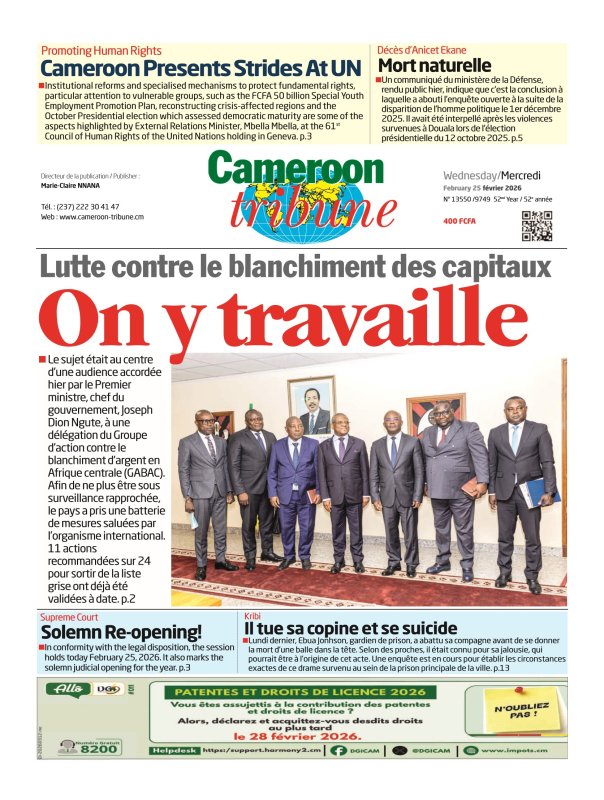
Promoting Human Rights: Cameroon Presents Strides At UN
- Par Eulalia AMABO
- 25 Feb 2026 09:49
- Likes
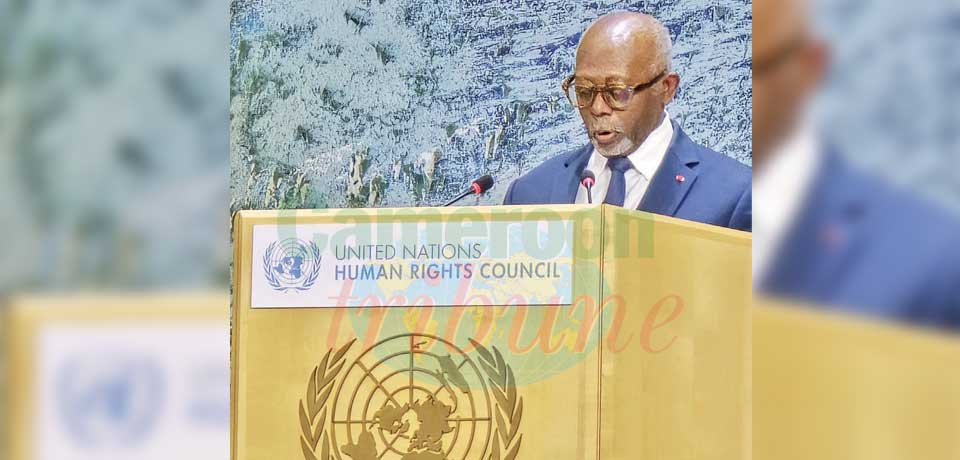
External Relations Minister Mbella Mbella while at the 61st Human Rights Council of the United Nations in Geneva highlighted various actions carried out by government to that effect.
Various institutional measures put in place by the government within the framework of promoting and protecting human rights and democracy in the country have been presented by External Relations Minister, Mbella Mbella, as head of the Cameroon delegation to the 61st Human Rights Council of the United Nations holding in Geneva. He took to the rostrum on February 23, 2026, same day of the opening plenary, highlighting the strides and challenges. In his statement, the Minister acknowledged the fact that Cameroon has made the respect for human rights a central focus of development, and the Preamble of the 1996 Constitution enshrines fundamental freedoms and equality before the law. At the institutional level, he said the Human Rights Commission of Cameroon, national courts, and several specialised mechanisms actively work to promote and protect fundamental rights. Indeed, since 2001, Cameroon has been home to the Sub-Regional Centre for Human Rights and Democracy in Central Africa, a symbol of its regional commitment, which is also reflected through its cooperation with African mechanisms, notably the African Court and the African Commission on Human and Peoples' Rights. “The recent Presidential election of October 2025 served as a suitable barometer for assessing the rule of law and democratic maturity in Cameroon. Public freedoms are exercised within the legal framework. The vitality of political pluralism and citizen participation reflects the democratic roots of our country. Under the strong leadership of His Excellency Paul Biya President of the Republic, whose commitment to peace is widely recognized, Cameroon continues to strengthen the rule of law and democratic governance,” Minister Mbella Mbella stated. He adds that special attention is given to vulnerable groups, including women, youth, people living with disabilities, and indigenous peoples. In this context, he specified that a Special Youth Employment Promotion Plan, with a budget of FCFA 50 billion for the 2026 fiscal year, is currently being implemented. These efforts, External Relations Minister said, continue despite persistent security challenges in certain regions of our country, notably the North West, South West, and Far North Regions which he added that the actions of defense and security forces, combined with reconstruction and reintegration programmes, have led to a notable improvement in the situation. He used the opportunity to express the gratitude of Cameroon to the Office of the United Nations High Commission for Human Rights in the process of gradually returning to normalcy, as well as the recent publication of its report on the situation in these regions, which contributes to an objective understanding of the efforts undertaken by authorities. While congratulating the High Commissioner for Human Rights, Volker Türk, for his unwavering commitment to the noble and universal cause of protecting human dignity, he reaffirmed the country’s commitment to a fairer, more united, and more peaceful world.
">
Various institutional measures put in place by the government within the framework of promoting and protecting human rights and democracy in the country have been presented by External Relations Minister, Mbella Mbella, as head of the Cameroon delegation to the 61st Human Rights Council of the United Nations holding in Geneva. He took to the rostrum on February 23, 2026, same day of the opening plenary, highlighting the strides and challenges. In his statement, the Minister acknowledged the fact that Cameroon has made the respect for human rights a central focus of development, and the Preamble of the 1996 Constitution enshrines fundamental freedoms and equality before the law. At the institutional level, he said the Human Rights Commission of Cameroon, national courts, and several specialised mechanisms actively work to promote and protect fundamental rights. Indeed, since 2001, Cameroon has been home to the Sub-Regional Centre for Human Rights and Democracy in Central Africa, a symbol of its regional commitment, which is also reflected through its cooperation with African mechanisms, notably the African Court and the African Commission on Human and Peoples' Rights. “The recent Presidential election of October 2025 served as a suitable barometer for assessing the rule of law and democratic maturity in Cameroon. Public freedoms are exercised within the legal framework. The vitality of political pluralism and citizen participation reflects the democratic roots of our country. Under the strong leadership of His Excellency Paul Biya President of the Republic, whose commitment to peace is widely recognized, Cameroon continues to strengthen the rule of law and democratic governance,” Minister Mbella Mbella stated. He adds that special attention is given to vulnerable groups, including women, youth, people living with disabilities, and indigenous peoples. In this context, he specified that a Special Youth Employment Promotion Plan, with a budget of FCFA 50 billion for the 2026 fiscal year, is currently being implemented. These efforts, External Relations Minister said, continue despite persistent security challenges in certain regions of our country, notably the North West, South West, and Far North Regions which he added that the actions of defense and security forces, combined with reconstruction and reintegration programmes, have led to a notable improvement in the situation. He used the opportunity to express the gratitude of Cameroon to the Office of the United Nations High Commission for Human Rights in the process of gradually returning to normalcy, as well as the recent publication of its report on the situation in these regions, which contributes to an objective understanding of the efforts undertaken by authorities. While congratulating the High Commissioner for Human Rights, Volker Türk, for his unwavering commitment to the noble and universal cause of protecting human dignity, he reaffirmed the country’s commitment to a fairer, more united, and more peaceful world.
">
Various institutional measures put in place by the government within the framework of promoting and protecting human rights and democracy in the country have been presented by External Relations Minister, Mbella Mbella, as head of the Cameroon delegation to the 61st Human Rights Council of the United Nations holding in Geneva. He took to the rostrum on February 23, 2026, same day of the opening plenary, highlighting the strides and challenges. In his statement, the Minister acknowledged the fact that Cameroon has made the respect for human rights a central focus of development, and the Preamble of the 1996 Constitution enshrines fundamental freedoms and equality before the law. At the institutional level, he said the Human Rights Commission of Cameroon, national courts, and several specialised mechanisms actively work to promote and protect fundamental rights. Indeed, since 2001, Cameroon has been home to the Sub-Regional Centre for Human Rights and Democracy in Central Africa, a symbol of its regional commitment, which is also reflected through its cooperation with African mechanisms, notably the African Court and the African Commission on Human and Peoples' Rights. “The recent Presidential election of October 2025 served as a suitable barometer for assessing the rule of law and democratic maturity in Cameroon. Public freedoms are exercised within the legal framework. The vitality of political pluralism and citizen participation reflects the democratic roots of our country. Under the strong leadership of His Excellency Paul Biya President of the Republic, whose commitment to peace is widely recognized, Cameroon continues to strengthen the rule of law and democratic governance,” Minister Mbella Mbella stated. He adds that special attention is given to vulnerable groups, including women, youth, people living with disabilities, and indigenous peoples. In this context, he specified that a Special Youth Employment Promotion Plan, with a budget of FCFA 50 billion for the 2026 fiscal year, is currently being ...
Cet article complet est réservé aux abonnés
Déjà abonné ? Identifiez-vous >
Accédez en illimité à Cameroon Tribune Digital à partir de 26250 FCFA
Je M'abonne1 minute suffit pour vous abonner à Cameroon Tribune Digital !
- Votre numéro spécial cameroon-tribune en version numérique
- Des encarts
- Des appels d'offres exclusives
- D'avant-première (accès 24h avant la publication)
- Des éditions consultables sur tous supports (smartphone, tablettes, PC)




Commentaires