

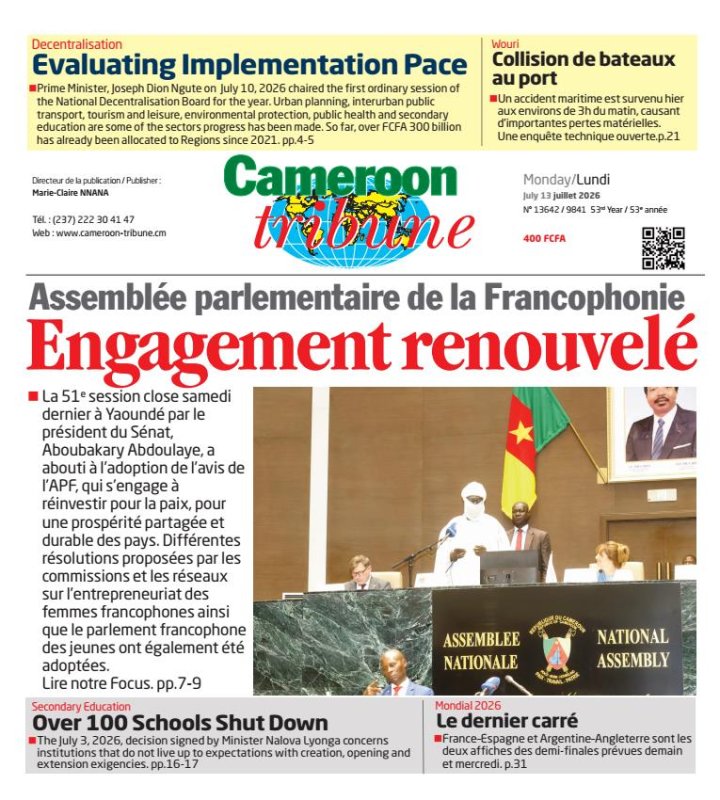
Below is a press release following the first ordinary session of the National Decentralisation Board held on July 10, 2026.
“T he Prime Minister, Head of Govern ment, His Excellency Joseph DION NGUTE, Chairperson of the National Decentralization Board, chaired, this Friday 10 July 2026, the first ordinary session of this body for the year 2026, from I p.m., at the auditorium of the Prime Minister's Office. In addition to his close aides, the session was attended by Members of Government, Members of Parliament, representatives of the Economic and Social Council and repre sentatives of Regional and Local Authorities (RLAs). There were six (6) main items on the agenda, including: 1. the opening speech by the Prime Minister, Head of Government, Chairperson of the National Decentralization Board (NDB); 2. report of activities carried out by the Permanent Secretariat of the National Decentralization Board during the recess period, presented by the Permanent Se cretary of the NDB; 3. statement by the Minister of Decentrali zation and Local Development on the theme: "State of play of the implementa tion of decentralization in the Regions 4. statement by the Minister of Finance on the theme: "Financing decentralization at regional level: current status and pros pects 5. statement by the President of the Asso ciation of Regions of Cameroon on the theme: "Assessment of the implementa tion of decentralization at regional level 6. statement by the President of the South West Regional Executive Council on the theme: "Assessment of the implementa tion of decentralization in the Regions with Special Status". In his opening remarks, the Prime Minister highlighted the significant progress made, since the last Board session on 19 December 2025, in establishing the regulatory frame work for the implementation of Law No. 2024/020 of 23 December 2024 on local taxation. This is reflected, in particular, by the signing of Decree No. 2026/ 01007/PM of 12 May 2026 to lay down conditions for the centralization, distribution and transfer of equalization tax revenue at the regional and interregional cooperation level, as well as the joint MINDDEVEL-MINFI Order No. 00000043/ AC/MINDDEVEL/MINFI of 15 May 2026 to lay down conditions for the establishment and organization of Local Tax Monitoring Units (USFL) within Regional and Local Authorities. Reporting on the activities carried out by the Permanent Secretariat of the National Decentralization Board during the recess period, the Permanent Secretary of the Board pointed out that, in addition to moni toring the implementation of the instructions of the Head of Government issued at the last Board session and contributing to the establishment of the legal framework for the decentralization process, the Permanent Secretariat has primarily been involved in assessing the implementation of Law No. 2024/020 of 23 December 2024 on local taxation, and monitoring various other issues of key importance to the decentralization process. In his statement, the Minister of Decentra lization and Local Development pointed out in particular that, the successful establish ment of the Regions since the first elections held on 6 December 2020 and the start of the second term of office following the elections of 30 November 2025, mark a major democratic milestone with particular significance regarding the political partici pation of traditional authorities. In the Re gions with Special Status, the North West and South West, this participation is reflected through a dedicated House which enables traditional authorities to deliberate on mat ters falling within their remit and to contri bute directly to the formulation of regional policies. From a regulatory perspective, the transfer of powers is being implemented concurrently with that of resources, according to a me thodical plan and in accordance with the di rectives of the Head of State. The Law of 23 December 2024 on local taxation grants the Regions direct shares of revenue from nine tax levies, thereby laying the irreversible foundations for their financial autonomy. As part of local governance and development, all the Regions have already adopted a Re gional Development Plan (RDP) in order to streamline regional objectives and set out clear priorities. In terms of prospects, there are plans to es tablish the Regions as key areas for colla borative governance, through ongoing consultation, rigorous planning, systematic monitoring and regular evaluation of actions carried out. Emphasis will also be placed on strengthening local taxation, budgetary dis cipline and revenue optimization, digital transition, as well as continuity and streng thening of local mediation. In his statement, the Minister of Finance explained that the funding model for the Regions revolves around two key instru ments, namely: budgetary allocations (the Common Decentralization Fund and sector- specific allocations resulting from the gradual devolution of powers) and tax revenue transfers. In addition to these two models, there are corrective measures, notably equa lization and inter-regional funding, which are mechanisms designed to ensure a more equitable distribution of resources amongst the regions and to reduce regional dispari ties. During the first term of office, funding for the Regions went from an annual allocation of 30 billion CFA francs between 2021 and 2023, at a rate of 3 billion per Region, to support their gradual establishment; this rose to 45.75 billion CFA francs in 2025 following the introduction of sector specific allocations. In 2026, the Regions receive 47.79 billion CFA francs in allocations, as well as a tax transfer amounting to 1 17.762 billion CFA francs. In terms of prospects, the Ministry of Finance intends, in particular, to finalize the confi guration of the information systems to enable the automatic transfer of funds al located to the Regions to FEICOM, and to continue modernising management tools and budgetary control mechanisms. The statement by the President of the ARC highlighted that the Regions had undergone a successful formal roll-out, with institutional operations observed to be running smoothly. However, these institutions operate on a day-to-day basis with human, logistics and material resources that fall far short of what is actually required to fulfil their ob jectives, as well as a regulatory framework that remains limited, with only six sector- specific implementing decrees signed over the past five years, out of the 20 expected. Furthermore, the budgetary situation is pre carious and highly dependent on the Central Government, with significant cash flow pres sures, despite a gradual increase in the overall budget of the Common Decentrali zation Fund (CDF). The implementation rate for projects planned during the first term of office has remained very low. There is also concern about the socio- political instability in the Regions plagued by security tensions, which severely hampers the work of regional institutions and the provision of local public services. For its current second term of office, the ARC has set the following priorities, amongst others: (i) a substantial and sustainable in crease in the budget of the Common De centralization Fund allocated to the Regions, (ii) the introduction of regulations governing the Local Public Service, and (iii) the insti tutionalization of a permanent dialogue between the State and the Regions. Addre...
Cet article complet est réservé aux abonnés
Déjà abonné ? Identifiez-vous >
Accédez en illimité à Cameroon Tribune Digital à partir de 26250 FCFA
Je M'abonne1 minute suffit pour vous abonner à Cameroon Tribune Digital !

- Votre numéro spécial cameroon-tribune en version numérique
- Des encarts
- Des appels d'offres exclusives
- D'avant-première (accès 24h avant la publication)
- Des éditions consultables sur tous supports (smartphone, tablettes, PC)







Commentaires