

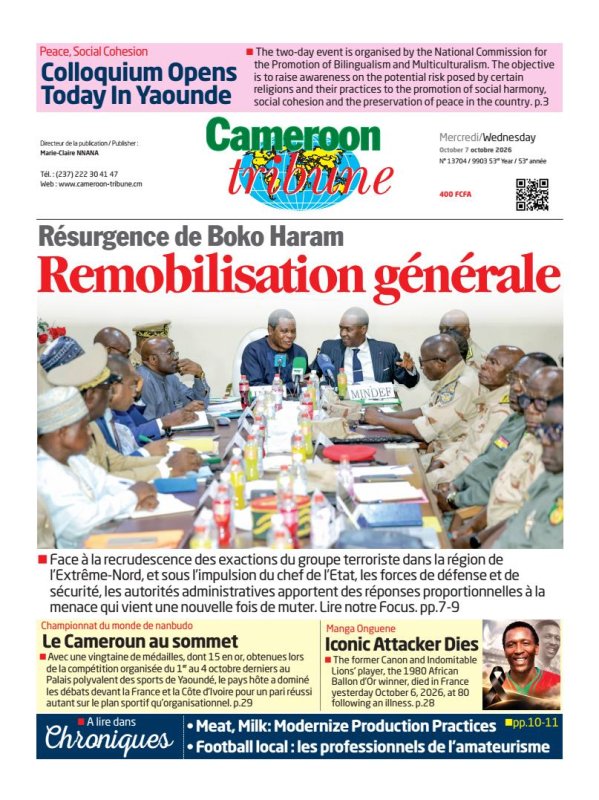
Meat, Milk: Modernize Production Practices
- Par Roland MBONTEH
- 07 Oct 2026 14:54
- Likes
C ameroon is a veritable meat and milk production hub given its natural potential in livestock breeding. Cattle constitute its main source of meat while poultry, pork, goat and sheep are complimentary sources. However, the country has been witnessing a dwindling meat production for the past few years. Going by statistics published by the Ministry of Livestock, Fisheries and Animal Industry, the current production of beef stands at 68,902 tons. For chicken, poultry farmers produce 38,914 tons while 27,914 tons of pork is produced. Goat and sheep meat production stands at 21,249 and 15,931 tons respectively. Apart from cattle and poultry farming which are relatively structured for commercial purposes, the rest are mainly done for sub sistence reasons by local breeders. Even though the cattle and poultry farming are semi-structured, production methods are still largely archaic. This lends credence to the dwindling production of the animal protein in the country. Cattle for instance, which is the main source of meat has witnessed a sharp decline. Beef production for the last two years has been falling sharply. In 2023, the country produced 130,000 tons. Production dropped by 27.5 per cent (-35,869 tons) as national production stood at 94,300 tons in 2024 and further declined to 69,902 tons in 2025. The shrinking production of the first source of animal protein in the country is worrisome as production remains below de mand, forcing prices to keep soa ring. It does not only affect hou sehold consumption patterns and budget but it equally impacts food prices in restaurants and hotels. According to the Ministry of Livestock, Fisheries and Animal Industry and other experts, the drop in beef production is attributed to environmental and climate change, citing specifically degradation of pastures and water scarcity in the northern regions which are the main production basins. Insecurity and cattle theft as well as lack of investment in the sector are also blamed for the shrinking production. Though the aforementioned factors are contributing to the sharp decline in beef and milk production, the main reason for the fall is the wide use of rudimentary and archaic pro duction methods by local farmers. The primitive methods practiced year-in and year-out can only produce low output. For example, in Cameroon 90 per cent of cattle are raised by pastoralists who practice extensive transhumance system. They move 100-300km with the cattle in search of water and pasture. This leads to weight loss of the cattle especially as there is no fattening system. Experts say a zebu takes 5-7 years to reach 250kg carcass in Cameroon compared to just 18-24 months in Brazil or South Africa to reach 350kg. With little or no investment in the sector by breeders, no planted pastures, no boreholes for water, cattle usually die more in the dry season when water sources dry off. As pasture becomes a problem for the cattle, so too is its milk productivity dropping to 0.5 litres per day as opposed to 15 litres per day in improved system. The archaic production methods with no artificial insemi nations, no regular vaccinations and no cold chain can only lead to a fall in productivity. Though the local Goudali, White Fulani, Red Fulani species are resistant, they produce low meat yield. There is also high calf mortality (15-20 per cent) as vaccination is irregular, meat loss to poor conservation because most of the slaughtering is done in the open air. Expert say about 30 per cent of meat loss is recorded because of the traditional slaughtering method used. For now, the country can only boast of two industrial slaugh terhouses in Yaounde and Ngaoundere for a herd of about 6 million cattle. For milk production, the story is the same with low produc tivity despite high demand which ranges between 300,000 to 630,000 tons for fresh and powder milk. For now, official figures from MINEPIA indicate that 176,618 tons of milk was produced in 2023. It slightly increased to 180,000 tons in 2024 and 183,286 tons in 2025. The deficit stands at 120,000 to 450,000 tons every year. The gap is filled by imports with Cameroon spending a whopping sum of about FCFA 75.6 billion to import the commodity. The amount is said to be increasing as demand surges. The low production of milk just like meat is attributed to the same archaic...
Cet article complet est réservé aux abonnés
Déjà abonné ? Identifiez-vous >
Accédez en illimité à Cameroon Tribune Digital à partir de 26250 FCFA
Je M'abonne1 minute suffit pour vous abonner à Cameroon Tribune Digital !

- Votre numéro spécial cameroon-tribune en version numérique
- Des encarts
- Des appels d'offres exclusives
- D'avant-première (accès 24h avant la publication)
- Des éditions consultables sur tous supports (smartphone, tablettes, PC)









Commentaires