

Fragmented Figures, Shared Facts: Cameroon, IOM Rethink Humanitarian Displacement Data
- Par Kimeng Hilton
- 20 Dec 2025 08:21
- 0 Likes
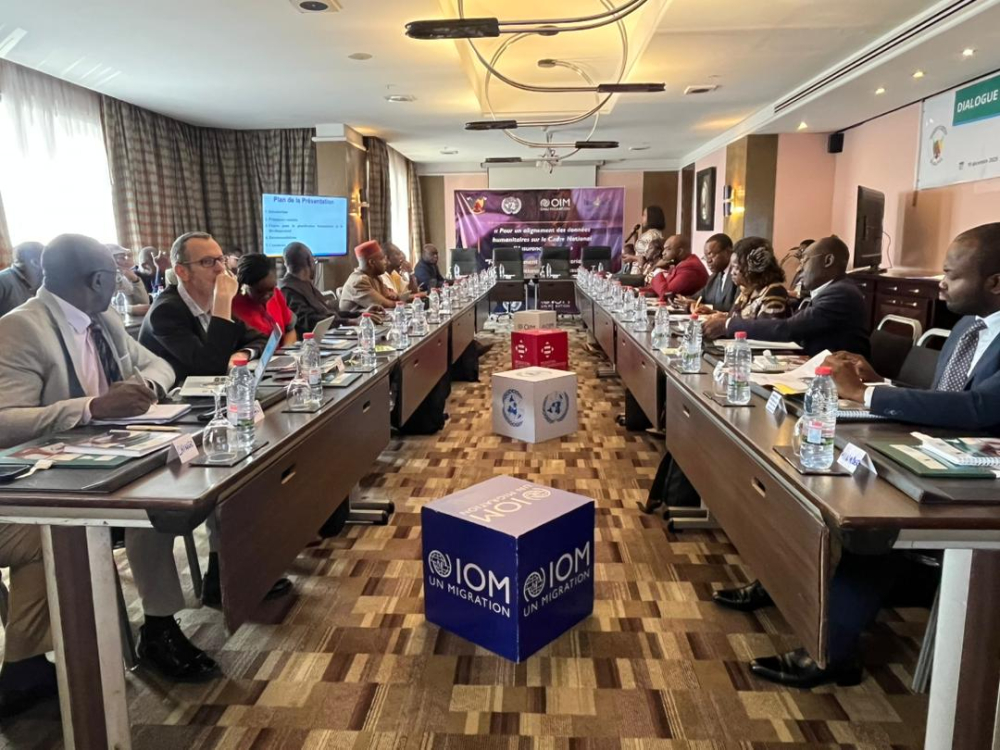
The International Organisation for Migration on December 19, 2025 organized a dialogue with Government of Cameroon.
Yaounde, December 19, 2025 - On December 19, 2025, the Cameroonian capital, Yaounde, became the setting for a crucial institutional dialogue that could reshape how humanitarian crises are understood, measured, and addressed in the country. The International Organization for Migration (IOM) convened senior representatives of the Government of Cameroon, national statistical institutions, humanitarian partners, and diplomatic actors for a high-level exchange focused on one critical issue - humanitarian data.
Beyond The Figures
At stake was more than methodology or statistics. The dialogue touched on questions of sovereignty, coordination, accountability, and protection, in a country grappling with one of Central Africa’s most complex and protracted humanitarian situations.
According to the Office for the Coordination of Humanitarian Affairs (OCHA), Cameroon hosted approximately 1.1 million Internally Displaced Persons (IDPs) and over 480,000 refugees in 2024, fleeing conflict, insecurity, and climate shocks (OCHA, 2024). Behind these figures lie millions of lives disrupted - and a growing recognition that without reliable, harmonized data, effective humanitarian response remains elusive.
Strategic Dialogue On Data, Governance
The institutional dialogue, organized by IOM, aimed to establish a common framework for cooperation between humanitarian actors and the National Statistical Information System (SNIS) of Cameroon. Participants examined how data on displacement, migration, and humanitarian needs are produced, shared, and integrated into national planning processes.
Opening the dialogue, Abdel Rahmane Diop, Head of Mission of IOM Cameroon - with coordinating responsibilities for Equatorial Guinea and São Tomé and Príncipe - recalled Cameroon’s international commitments under the Global Compact for Safe, Orderly and Regular Migration (GCM).
Cameroon’s Commitments
“Cameroon adopted the Global Compact and, in 2022, committed to improving Objective Number One: better migration data,” Diop stated. “This commitment naturally led us to reflect on the humanitarian dimension of migration data and the need to define it together with government institutions.”
IOM, he noted, has worked for more than a decade on migration and displacement data using tools such as the Displacement Tracking Matrix (DTM). Yet, he emphasized that data ownership and interpretation must increasingly be shared with national institutions.
“It is not only about producing data,” Diop said. “It is about creating bridges - defining humanitarian data together, sharing a common understanding, and clearly identifying the real needs of people on the move, especially internally displaced persons.”
Cameroon’s Protracted Humanitarian Crisis
Cameroon’s humanitarian crisis is multifaceted and geographically widespread. In the North West and South West Regions, armed conflict linked to sociopolitical tensions has persisted for several years, triggering massive displacement and disrupting livelihoods, education, and health services. In the Far North Region, attacks by armed groups, combined with inter-community tensions, continue to force families from their homes.
Lake Chad Basin Challenges
Meanwhile, the Lake Chad Basin faces recurring climate shocks, including floods, droughts, and land degradation, which undermine agricultural production and increase competition over scarce resources. These environmental pressures interact with insecurity, deepening vulnerability.
According to OCHA, these overlapping crises have strained host communities and social infrastructure, complicating efforts to move from emergency response toward durable solutions (OCHA, 2024). Humanitarian actors rely heavily on data to identify needs, prioritize interventions, mobilize resources, and monitor impact.
However, as the Yaounde dialogue highlighted, the way humanitarian data is currently produced in Cameroon remains fragmented.
Obstacle To Effective Response
Over the years, humanitarian actors in Cameroon have developed robust but often parallel data systems. Needs assessments such as the Multi-Sectoral Needs Assessment (MSNA) and displacement monitoring tools like the DTM that have generated valuable insights. Yet these systems often operate outside the National Statistical Information System, and without systematic alignment with the National Quality Assurance Framework (CNAQ).
Consequences Of Fragmentation
This fragmentation has led to several challenges. Such as multiple surveys using different definitions, indicators, and methodologies; limited interoperability between databases and platforms; absence of a common, validated data repository; and weak accountability toward national statistical authorities, notably the National Institute of Statistics (INS).
Participants noted that this situation can result in inconsistent figures, duplication of assessments, survey fatigue among affected populations, and difficulties in linking humanitarian action to national development strategies.
Legal, Institutional Imperatives
The dialogue took place against a clear legal backdrop. Law No. 2020/010, governing statistical activity in Cameroon, assigns the State responsibility for coordinating official statistics and ensuring quality, coherence, and comparability. The law reinforces the role of the INS in quality assurance and standard setting.
Internationally, Cameroon aligns with the recommendations of the Expert Group on Refugee, IDP and Statelessness Statistics (EGRISS), which promotes the integration of forced displacement data into national statistical systems to support evidence-based policymaking (EGRISS, UN Statistical Commission). The challenge, participants agreed, lies not in the absence of frameworks, but in operationalizing collaboration between humanitarian and national actors.
Objectives Of The Dialogue
The overall objective of the Yaounde dialogue was to establish a framework for institutional collaboration between the SNIS and humanitarian actors, ensuring that humanitarian data is reliable, harmonized, and nationally owned.
More specifically, the dialogue aimed to assess compliance of existing humanitarian data systems with national regulations; identify obstacles to integrating humanitarian data into the National Statistical Development Strategy (SNDS); propose mechanisms to align methodologies such as MSNA and DTM with the C...
Cet article complet est réservé aux abonnés
Déjà abonné ? Identifiez-vous >
Accédez en illimité à Cameroon Tribune Digital à partir de 26250 FCFA
Je M'abonne1 minute suffit pour vous abonner à Cameroon Tribune Digital !

- Votre numéro spécial cameroon-tribune en version numérique
- Des encarts
- Des appels d'offres exclusives
- D'avant-première (accès 24h avant la publication)
- Des éditions consultables sur tous supports (smartphone, tablettes, PC)






Commentaires