
Breaking The Silence: Youth With Disabilities Gird Loins For Dignity, Sexual Rights And Inclusion
- Par Kimeng Hilton
- 12 Feb 2026 23:35
- 0 Likes
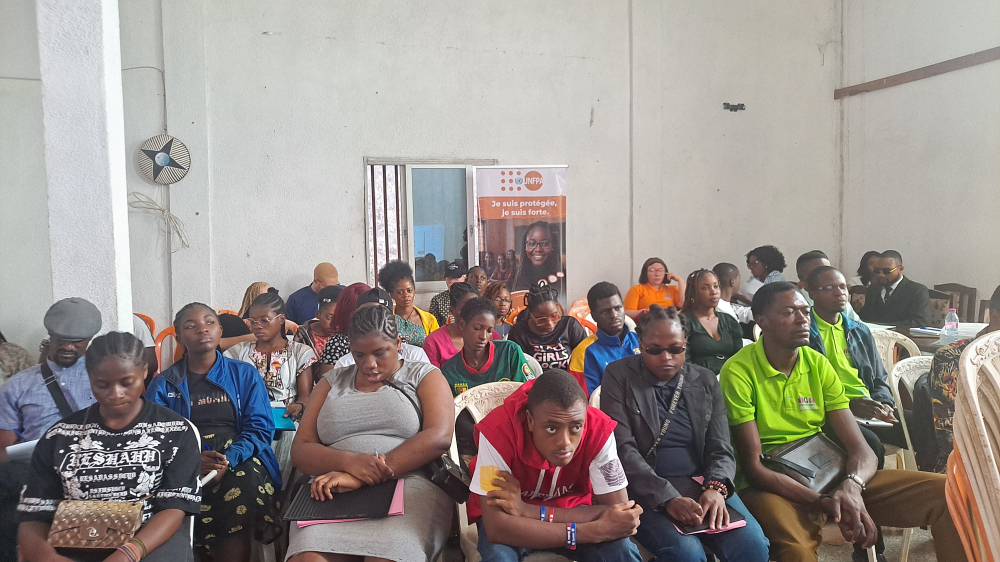
The “Association of Advocates and Fighters for Vulnerable Individuals and People with Disabilities” ASMIBA-PVSH, is holding a two-day workshop in Yaounde from February 12-13, 2026.
In a conference hall in Cameroon’s capital, Yaounde, a quiet revolution is taking place. It is not televised, and there are no marching bands. Instead, the sound of revolution here is the rhythmic typing on braille notepads and the occasional tapping of white canes on the floor. The rapid, fluid motion of hands signing in Sign Language, and the determined voices of 50 young people who have spent their lives being told what they cannot do. Now, they are gathered to learn what they can do: take control of their bodies, protect themselves from violence, and claim their place in the future of their country.
Landmark Training
From February 12-13, 2026, the “Association of Advocates and Fighters for Vulnerable Individuals and People with Disabilities,” ASMIBA-PVSH, in partnership with the United Nations Population Fund, UNFPA, convened a landmark workshop. Its title is a mouthful - “Sexual and Reproductive Health, Family Planning, Gender-Based Violence Prevention, and Youth Participation” - but its mission is profound.
It seeks to equip 50 young people with diverse disabilities with the tools to become peer educators. In doing so, the initiative aims to shatter the suffocating stigma that surrounds disability and sexuality, and to dismantle the systemic barriers that leave this population doubly vulnerable.
Long Considered Otherwise
For too long, society has viewed people with disabilities through a lens of pity or benevolence. They are seen as recipients of charity, objects of aid, or worse, asexual beings whose reproductive health is irrelevant. But in this hall in Yaounde, that narrative is being aggressively challenged. The message is clear: people with disabilities are sexual beings, they are rights-holders, and they are the architects of their own dignity.
The Statistics Of Silence
To understand the urgency of this workshop, one must first confront the harsh realities of public health in Cameroon, particularly for the youth. Sexual and Reproductive Health (SRH) is a critical concern nationwide, with adolescents and young people bearing the brunt of the crisis.
The data paints a grim picture. In 2018, the National Institute of Statistics noted that 24% of adolescents had already begun their procreative lives. Early pregnancy remains a scourge that shatters the educational and economic dreams of countless young girls.
The lack of access to contraceptive methods is a significant driver of this trend. The unmet need for family planning among adolescents aged 15-19 stands at a staggering 26%. While the modern contraceptive prevalence rate is 22.6% for young women aged 20-24, it drops to a mere 10.3% for those aged 15-19. This gap is not just a statistic; it represents thousands of unplanned pregnancies and truncated futures.
HIV/AIDS Challenges
Simultaneously, the shadow of HIV/AIDS looms large. While the general prevalence was around 1.3% in 2018, the epidemic is heavily feminized among the youth. The National AIDS Control Committee reported a terrifying disparity: out of 10 new HIV infections among young people aged 15-24, seven are girls. This vulnerability is rooted in a profound lack of knowledge - comprehensive knowledge of HIV is only 41% among young women and 36% among young men.
Added to this complex web of health risks is the pervasive issue of Gender-Based Violence, GBV. Women in Cameroon face a high risk of violence; 13% of women aged 15-49 have experienced sexual violence in their lifetime, compared to 6% of men. However, for young people with disabilities, these alarming statistics are not just numbers - they are multipliers. They face what experts call "double vulnerability." They are marginalized first by their youth and gender, and again by their disability.
Neglect Of A Whole Community
Olivier Tombi a Sanam, President of ASMIBA-PVSH, does not mince words when describing the neglect his community faces. "With our partner, UNFPA, we have made the observation that in terms of reproductive and sexual health, family planning, people with disabilities are often neglected," he explains. "This is a proof statistic. Very few young women with disabilities have access to reproductive and sexual healthcare and family planning services."
This exclusion is not merely a logistical failure; it is a philosophical failure. It stems from a societal reluctance to acknowledge that people with disabilities have sexual lives, desires, and reproductive rights. By ignoring this, the system has pushed them into the shadows, where they are easy prey for exploitation and abuse.
The Architecture Of Inclusion
Walking into the workshop room, one is immediately struck by the level of preparation and adaptation. This is not a standard training where a lecturer stands at a podium and speaks to a passive audience. It is a masterclass in inclusivity, designed to tear down the physical and communicative barriers that usually exclude people with disabilities from such spaces.
The participants represent a cross-section of Cameroon’s disability community. There are individuals with visual impairments navigating the space with white canes. Those with hearing impairments communicating fluidly via sign language interpreters. Individuals with motor disabilities using wheelchairs or other assistive devices; those with intellectual disabilities requiring simplified learning materials. As well as individuals with albinism and those of short stature.
Innovative Approach
Mrs. Pacelie Edima, a specialist in gender and inclusion of people with disabilities certified by the International Labour Organisation, ILO, serves as one of the workshop facilitators. She emphasizes the sheer innovation of this approach. "Generally, the actions aimed at fighting against gender-based violence do not take into account young people with disabilities," she notes. "So, to see that we are training educators on the prevention of gender-based violence and even on sexual and reproductive health is really innovative." The methodology employed is "participatory and inclusive." It recognizes that you cannot teach about rights if the method of teaching denies those rights.
Adapted Learning
On a technical level, the adaptations are rigorous. For the visually impaired, documents are provided in Braille, and content is maximized to ensure auditory learning is effective. Guides and accompanists are present to assist. For the hearing impaired, sign language interpreters are a constant presence, translating the complex terminology of sexual health and legal rights into a visual language. For those with intellectual disabilities, the content is simplified, using clear, non-complex visuals to convey concepts like consent and contraception.
"We have adapted the teaching methods, especially by using a sign language interpreter... and by maximizing the content to enable everyone have access to the quality training," Pacelie Edima explains. "So, it is really an inclusive training."
Holistic Needs
The agenda itself is a testament to the holistic needs of the participants. Over two days, they will cover a vast terrain. Day One focuses on the foundational health knowledge: Generalities on Sexual and Reproductive Health, Comprehensive Sexuality Education, HIV and STI Prevention, and Family Planning adapted for youth. The afternoon sessions tackle the difficult but necessary subjects of Gender and GBV Prevention, Mental Health, and Menstrual Health.
Day Two shifts toward action and advocacy. The participants discuss SRH Service Delivery Structures, engaging in brainstorming sessions about the specific constraints they face - be it inaccessible clinics or hostile medical staff. They then move to modules on Youth Participation, Leadership, and Communication Techniques adapted for their specific contexts. The training culminates in Practical Simulation Exercises, allowing them to role-play the difficult conversations they will soon be leading in their own communities.
The Scourge Of Double Vulnerability
While the modules cover health and politics, the specter of violence looms large over the proceedings. For women with disabilities, the risk of Gender-Based Violence, GBV is not a possibility; it is often a daily reality.
Olivier Tombi a Sanam speaks with a quiet intensity about this issue. "It must be stated that women with disabilities are doubly exposed. Not only because they are women, but also because of their disabilities. Many women and young women have testified to me that they were raped."
The stories shared in the workshop are harrowing. Olivier recounts testimonies of women being raped in taxis - public transport vehicles where they are essentially trapped with a driver who takes them to unknown locations. Others are abused by strangers or even caregivers who exploit their dependence. "They were raped either by strangers, or in taxis. They were taken to an unknown place where they are raped and abused," he says.
Also Psychological, Verbal
But the violence is not always physical or sexual. It is also psychological and verbal. "The violence is not only sexual, it is also verbal - of all kinds," Olivier adds. This constant barrage of dehumanization strips away self-esteem and reinforces the societal narrative that people with disabilities are "less than."
Mrs. Edima expands on this concept of "double vulnerability" in her sessions. She explains that the intersection of gender and disability creates a unique risk profile. A woman with disability is less likely to be believed if she reports abuse, less able to physically escape an attacker, and less likely to access the justice system due to physical or procedural barriers. "These young people face a double vulnerability, not only related to gender, but also related to the disability," she says.
GBV In Detail
The workshop tackles this head-on by teaching the concepts of gender, the different types of violence, and, crucially, the mechanisms for response. "In detail, we introduce them to the concept of gender and the different types of gender-based violence," Pacelie explains. "And in relation to each type of violence, the ways to prevent it."
The message is empowerment through knowledge. The participants are taught that they have rights, that their bodies belong to them, and that violence - whether from a stranger, a family member, or a partner - is a crime. "It must be denounced," Pacelie insists. "And we, at another level, encourage much more awareness because many do not even know where to go to denounce."
More Than A White Cane
At the heart of Olivier Tombi a Sanam’s philosophy is a radical redefinition of what it means to support people with disabilities. He argues that true support goes far beyond the medical model of providing crutches or white canes.
"I have a white cane in my bag," he acknowledges. "But I said to myself, if we think that this is what we need, I think it's not true. It is necessary to have this autonomy, but it's not just that. We need to be considered, we need people to trust us, we need people to give us opportunities to work."
This is the core of the workshop’s justification. If we want to strengthen the dignity of a human being, we must give them the autonomy to make choices about their own lives. "Because if we want to strengthen the dignity of man, if we want to make man autonomous, it is necessary that this category know how to take care of their reproductive and sexual health and decide whether or not to have children; and be able to control births," Olivier argues.
It Is All About Dignity
This agency is the essence of dignity. Olivier posits that dignity is inextricably linked to the ability to make difficult choices: the choice to have children or not, the choice to protect oneself from disease, the choice to participate in the civic life of the nation. "There is no dignity without the choice to have or not have children. There is no dignity without being able to protect oneself against gender-based violence," he states.
The training is designed to restore this agency. By teaching these young people about their reproductive health, they are no longer passive subjects of public health campaigns; they become active agents of their own well-being. By teaching them about their rights and how to denounce violence, they move from being victims to being defenders of justice.
Uphill Task Ahead
Olivier admits that the path ahead is not easy. He is fully aware of the challenges that await them on the field. "Yes, we are well aware of the challenges. And these challenges constitute our motivation," he says. "To be motivated, there must be a challenge, there must be a higher interest."
He speaks of "positive disappointment" - the idea that the struggle itself is proof of one's humanity and drive. The obstacles they face are not reasons to quit; they are the very reasons they must persist.
The Peer Educator Model Ripple Effect
The logic of the workshop is exponential. By training 50 young people, the aim is not just to change 50 lives, but to touch thousands. These 50 individuals are being transformed into "peer educators." They are not just learning for themselves; they are learning to teach.
The choice of peer educators is strategic. Olivier explains that the population of people with disabilities is large, but the number of specialized social workers or health professionals trained to address their specific needs is small. "This is why we decided to mobilize 50 peer educators because the population is large and there are few workers for the mission."
Peer education is a powerful tool because it bypasses the trust issues that often exist between marginalized communities and State authorities. A young woman in a wheelchair is more likely to listen to another young woman in a wheelchair talking about contraception or self-defense than a doctor who does not understand her lived experience.
Really Practical, Active
"We expect participants to be able,...
Cet article complet est réservé aux abonnés
Déjà abonné ? Identifiez-vous >
Accédez en illimité à Cameroon Tribune Digital à partir de 26250 FCFA
Je M'abonne1 minute suffit pour vous abonner à Cameroon Tribune Digital !
- Votre numéro spécial cameroon-tribune en version numérique
- Des encarts
- Des appels d'offres exclusives
- D'avant-première (accès 24h avant la publication)
- Des éditions consultables sur tous supports (smartphone, tablettes, PC)




Commentaires