

Beyond Maintenance: How A Cameroonian’s Invention Can Saves Billions
- Par Kimeng Hilton
- 01 Apr 2026 16:07
- 0 Likes
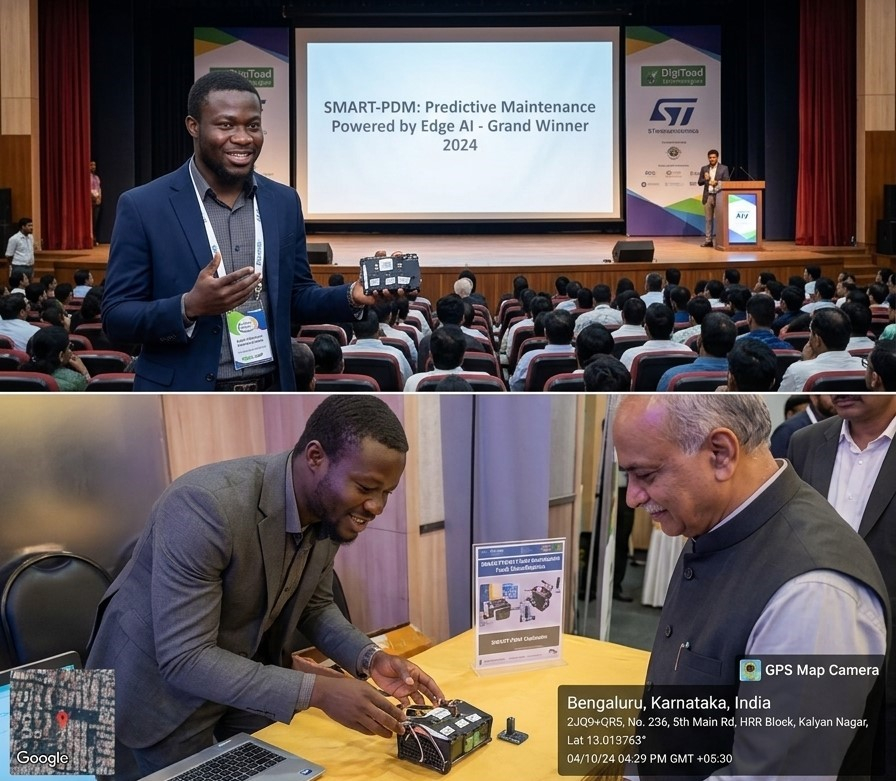
His groundbreaking project helps to predict motor faults before the occur, thereby saving huge amounts of money - and time.
Ngum Breayon Kwe, a 22-year-old Cameroonian engineering student, secured the Grand Prize at the Edge AI Innovation Challenge 2024, marking a significant milestone for African representation in global technology. Competing against 200 teams from over 60 Indian universities, Kwe and his teammate Vishal Yadav emerged victorious with their groundbreaking project, Smart Predictive Maintenance for Motors (SMART-PDM). The invention, which earned the team a cash prize of 1 lakh Indian rupees (approximately 620,150 FCFA), promises to revolutionize industrial efficiency by predicting equipment failures before they occur.
Shifting Industry Standards
The core of the innovation lies in its ability to shift industrial standards from reactive or preventive maintenance to predictive intelligence. While traditional methods rely on routine checks or fixing machines after they break, SMART-PDM uses an STM32 Arm Cortex-M microcontroller to process data directly on the device.
Role Of AI
By leveraging two artificial intelligence techniques and multiple machine learning models, the system identifies anomalies and classifies faults with high precision. Because the data is processed at the "edge" rather than the cloud, the system remains fast, secure, and functional even in remote or off-grid industrial environments.
Electricity Consumption
The economic implications of this technology are vast. Industrial motors consume nearly 45% of global industrial electricity and are the backbone of sectors like manufacturing, energy distribution, and agro-processing. Currently, unplanned motor failures cost global industries billions of dollars annually due to production halts and equipment damage. Kwe’s SMART-PDM mitigates these losses by providing continuous monitoring, extending motor lifespans, and optimizing energy usage.
Sharda University Student
The project was the result of a rigorous 10-month development phase at Sharda University, where Kwe refined three separate iterations of the product. Under the mentorship of Prof. Pallavi Gupta, Kwe utilized the university’s IPDC Lab and project sponsorship schemes to move the innovation through various Technology Readiness Levels.
Kwe’s “Tradition”
This academic excellence is a hallmark of Kwe’s career; he was previously...
Cet article complet est réservé aux abonnés
Déjà abonné ? Identifiez-vous >
Accédez en illimité à Cameroon Tribune Digital à partir de 26250 FCFA
Je M'abonne1 minute suffit pour vous abonner à Cameroon Tribune Digital !

- Votre numéro spécial cameroon-tribune en version numérique
- Des encarts
- Des appels d'offres exclusives
- D'avant-première (accès 24h avant la publication)
- Des éditions consultables sur tous supports (smartphone, tablettes, PC)









Commentaires