

“Woe to Those Who Manipulate God”: Pope’s Stern Warning To Profiteers Of Anglophone Conflict
- Par Kimeng Hilton
- 16 Apr 2026 16:26
- 0 Likes
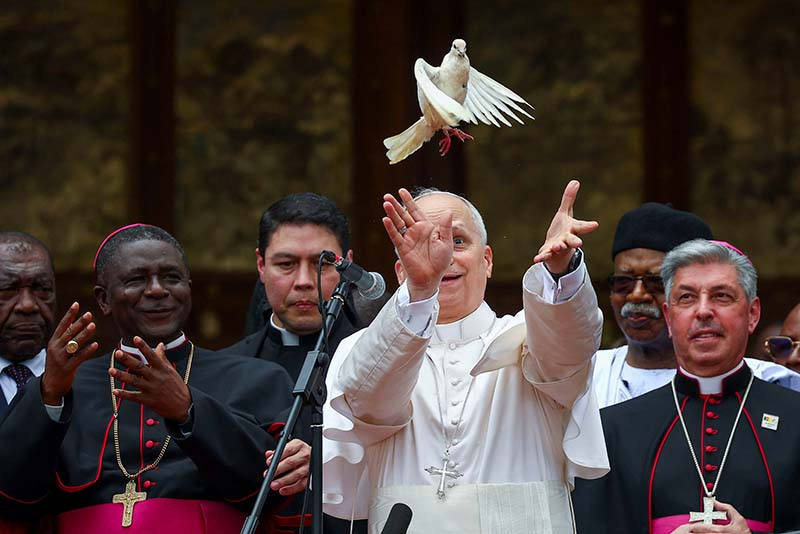
On his visit to Bamenda on Thursday April 16, 2026, Pope Leo XIV held a meeting with the clergy and civil society.
In a city where the air has long been thick with the smoke of burning villages and the silence of shuttered schools, a different sound echoed through the streets of Bamenda in Cameroon’s North West Region this Thursday April 16, 2026. The sound of thousands of voices lifted in a desperate, joyful plea for peace.
As A Pilgrim
Pope Leo XIV, arriving as a pilgrim to one of Cameroon’s zones, stood within the walls of St. Joseph’s Cathedral Big Mankon, Bamenda to offer more than just prayers. He offered a searing indictment of the "masters of war" and a profound message of solidarity to a population that has felt abandoned by the global community for nearly a decade.
The Landscape Of A Prolonged War
To understand the gravity of the Pope’s visit, one must understand the soil upon which he stood. Since 2017, the North West and South West Regions of Cameroon have been locked in a brutal cycle of violence known as the "Anglophone Crisis." For the residents of Bamenda, "normalcy" is a distant memory.
The conflict has claimed hundreds of lives, displaced nearly a million people, and left an entire generation of children without a consistent education due to school boycotts and the targeting of teachers. In this "Remote part of Africa," as Archbishop Andrew Nkea described it, the Pope’s presence was viewed by many as a miraculous intervention.
Testimonies of Terror
The centerpiece of the visit was an emotional peace meeting where the Pope sat not as a lecturer, but as a witness. Among the most harrowing accounts was that of Sister Carine Tangiri Mangu, a religious sister who, only months prior, was kidnapped by separatist fighters.
“We were held hostage for three days and three nights,” she told the Holy Father, her voice steady but laden with the weight of the ordeal. “During those days and nights, we neither slept nor ate. What kept our hope alive was the rosary.”
Rev. Sister’s Horror Tale
Sister Carine’s story is not an outlier. It is the reality for consecrated women and men who refuse to abandon their flocks in the "red zones." Her testimony highlighted the unique role of the Church in this conflict - often the only institution left standing when the state and social services have had to struggle to maintain control.
The interreligious nature of the suffering was further underscored by Mohammed Abubakar of the Buea Central Mosque. He recounted the horrific "Ngabur Massacre" and the targeted killings of the Mbororo ethnic community. His plea was simple and piercing: “Holy Father, please help us to have peace again.”
Denunciation Of War-Profiteers
When Pope Leo XIV rose to speak, the atmosphere shifted from mourning to a fierce, prophetic demand for justice. Eschewing the diplomatic caution often expected of such visits, the Pope took aim at the global and local actors who profit from the bloodshed.
“The masters of war pretend not to know that it takes only a moment to destroy, yet often a lifetime is not enough to rebuild,” the Pope declared. His voice rose as he addressed the economic drivers of the conflict, denouncing those who “rob your land of its resources and invest much of the profit in weapons.”
Forgotten Conflict?
In a world currently preoccupied with conflicts in Europe and the Middle East, the Pope’s focus on the "endless cycle of destabilization" in Cameroon served as a reminder that African lives are often the currency spent in global resource wars. He was particularly scathing toward those who use the Divine as a shield for atrocity: “Woe to those who manipulate religion and the very name of God for their own military, economic, and political gain.”
The Architecture Of Peace
Despite the darkness of the testimonies, the meeting also showcased the resilience of local leadership. The Rev. Fonki...
Cet article complet est réservé aux abonnés
Déjà abonné ? Identifiez-vous >
Accédez en illimité à Cameroon Tribune Digital à partir de 26250 FCFA
Je M'abonne1 minute suffit pour vous abonner à Cameroon Tribune Digital !
- Votre numéro spécial cameroon-tribune en version numérique
- Des encarts
- Des appels d'offres exclusives
- D'avant-première (accès 24h avant la publication)
- Des éditions consultables sur tous supports (smartphone, tablettes, PC)






Commentaires