

The End Of Cheap Fuel: Why Official Fuel Is Suddenly Winning In Maroua
- Par Kimeng Hilton
- 23 Apr 2026 23:32
- 0 Likes
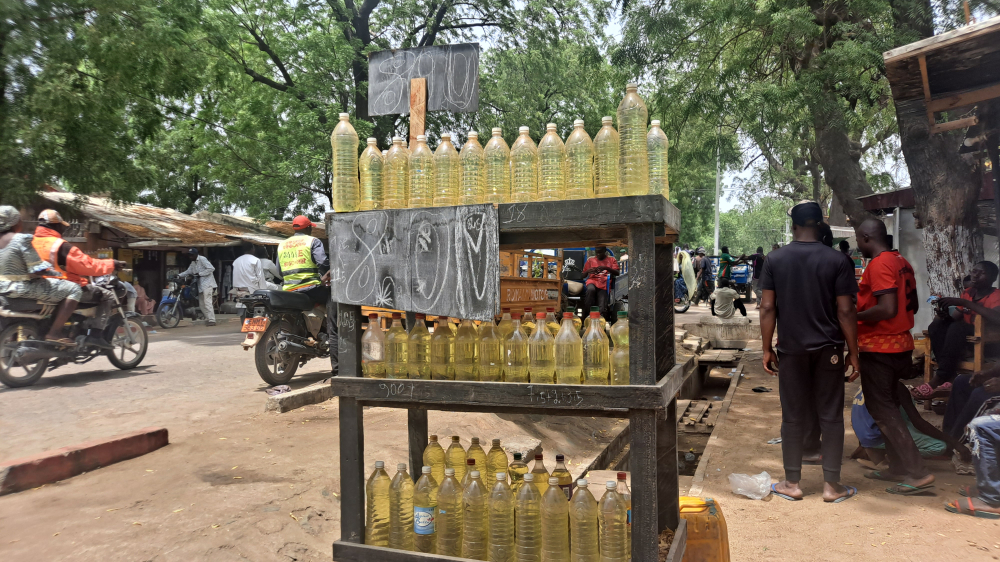
A combination of factors has raised the cost of contraband fuel to almost the same level with filling station Premium Motor Spirit, PMS or “Super.” To the advantage of filling stations.
In the dusty, sun-baked streets of Maroua, the sound of motorcycles revving and taxis honking has long been the heartbeat of the capital of Cameroon’s Far North Region. But beneath the cacophony of daily commerce, a silent and drastic economic shift is taking place. A sudden and sharp increase in the price of contraband fuel has fundamentally altered the arithmetic of survival for the city’s transport workers.
Combination Of Factors
For years, the informal fuel market, known locally as "zoua-zoua," reigned supreme due to its extreme affordability. However, over the last two months, a convergence of geopolitical tensions, post-election shocks, and border post closures in Nigeria has sent prices skyrocketing. The result is a paradoxical economic landscape: official filling stations are experiencing an unprecedented boom in revenue, while the transporters who keep the city moving are seeing their profit margins vanish.
The Filling Station’s Windfall
For Amada Adama Ibrahim, the manager of a major filling station in Maroua, the current crisis is a blessing. Where once the forecourt might have been quiet, with customers drifting toward cheaper street vendors, the pumps are now busy. "It has been good for us," Amada admits. "Since 'zoua-zoua' has seen a price increase and is currently at 750 or 800 CFA francs per liter, we are benefiting."
The dynamic is rooted in simple economics. For years, the price gap between official fuel and the contraband product was too wide to ignore. "At one point it was 400 or 450 CFA francs a liter," Amada recalls. Today, a liter of "Super" at Amada’s station sells for 867 CFA. Compared to the 800 CFA charged on the black market, the 67-franc difference is negligible.
Rediscovering The Value Of Quality
Amada estimates that his station’s revenue has jumped by nearly 45%. "It has almost doubled our sales," he exclaims. Beyond the price, he believes consumers are rediscovering the value of quality. "At the pump, you are guaranteed the quantity and quality. It’s unleaded and there is no dirt, unlike adulterated fuel."
While Amada is unsure of the exact cause - citing rumors ranging from regional instability to the Iran-Israel war - the result is clear: after years of losing ground to the black market, the formal pumps of Maroua are flowing freely once again.
The Geometry Of Supply
To understand why "zoua-zoua" prices have surged, one must look toward the shifting geopolitics of the Nigeria-Cameroon border. Yaouba Aboubakar, a 47-year-old commercial motorcycle rider, explains that the logistics of illicit trade are in turmoil.
Previously, fuel entered through Banki, a border town close to Mora. However, Yaouba notes that the Banki corridor has been blocked. "Fuel doesn't come out toward Banki anymore; they blocked it. It now comes through Mubi, further south."
This rerouting introduces a friction cost that has warped local logic. In Mora, which is geographically closer to the source, prices actually spiked higher than in Maroua, peaking at 1,000 CFA per liter before settling near 900 CFA. The convergence of the October 2026 post-election crisis and these border blockages has squeezed the supply, driving the informal price up by more than 200 CFA in a matter of weeks.
Vanishing Profits On The Long Haul
If station managers are the winners, long-distance drivers are the primary losers. Bouba, a 27-year-old driver who navigates the 215-kilometer route between Maroua and Garoua, paints a bleak picture.
"Previously, it used to be 450 or 500 F here in Maroua," Bouba recounts. "But now the liter has become 800 F. We aren't managing well."
Bouba’s problem is the rigidity of his customers' income. To cover his costs, he tried to raise the fare from 3,500 F to 5,000 F, but the market pushed back. "The customer won't pay. They want the price stable at 3,000 F. Because of that, a round trip only leaves you with 5,000 F in profit, whereas before we managed at least 10,000 F."
A 50% drop in take-home pay is catastrophic. Bouba is trapped in a Faustian bargain: using the "zoua-zoua" that he knows damages his engine just to keep fares low enough to attract passengers who are themselves struggling to survive.
The Urban Grind
Within Maroua city, the battle is psychological. Jean de Dieu Gawara, a 37-year-old motorcycle rider, describes a daily war of fares. When he attempts to raise a ride's price by a mere 25 or 50 CFA, he is met with hostility.
"They tell you, 'Is it me who increased the price of fuel?'" Jean de Dieu recounts. Passengers argue that because riders have access to "birds" (smuggled fuel) at 800 F—ignoring that this is double the old price- they have no right to complain.
This "It wasn't me" chorus encapsulates the disconnect between global macroeconomics and the street. Furthermore, riders who rent their bikes are burdened by fixed costs. "The motorcycle owners' 'contract' hasn't changed," Jean de Dieu notes. "You still have to pay 2,000 or 3,000 F a day to the owner. You have to struggle just to make that amount."
A Tale of Two Economies
The fuel crisis in Maroua reveals a stark divergence. The formal sector is seeing a renaissance as the rising cost of "zoua-zoua" acts as an inadvertent subsidy for regulated stations. From a governmental perspective, this looks like a success: a shift toward a regulated, safer, and more taxable market.
However, the transport sector - the city’s circulatory system - is ischemic. Drivers are absorbing the shock of higher fuel costs but cannot transmit them to passengers whose purchasing power has also been eroded. Reported income drops of 40-50% among drivers represent meals skipped and school fees unpaid.
Delicate Equilibrium
For now, the system limps along on desperation. The station pumps hum and the motorcycles roar, but the delicate equilibrium between the station's windfall...
Cet article complet est réservé aux abonnés
Déjà abonné ? Identifiez-vous >
Accédez en illimité à Cameroon Tribune Digital à partir de 26250 FCFA
Je M'abonne1 minute suffit pour vous abonner à Cameroon Tribune Digital !

- Votre numéro spécial cameroon-tribune en version numérique
- Des encarts
- Des appels d'offres exclusives
- D'avant-première (accès 24h avant la publication)
- Des éditions consultables sur tous supports (smartphone, tablettes, PC)







Commentaires