

Suspension Of Maize Imports : Cameroon Moves To Shield Local Farmers From Market Inundation
- Par Kimeng Hilton
- 12 May 2026 12:39
- 0 Likes
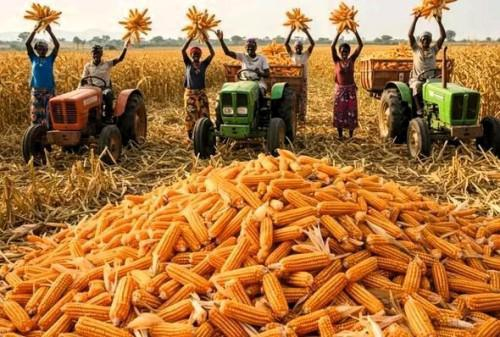
A May 8, 2026 correspondence by the Minister of Trade directs concerned government ministries and departments to immediately stop issuing new maize import permits. And to put on hold the implementation of existing licences.
In a decisive and "very urgent" policy shift aimed at stabilizing the domestic agricultural market, the Cameroonian government has announced the immediate and indefinite suspension of maize (corn) import permits. The directive, issued by the Minister of Trade, Luc Magloire Mbarga Atangana, comes as a direct response to a burgeoning crisis of "mévente" - poor sales and market stagnation - affecting local producers who are currently struggling to compete with a massive influx of foreign grain.
After High-level Talks
The official correspondence, dated May 8, 2026 (No. 0424 /MINCOMMERCE/CAB), follows a high-level inter-ministerial meeting held on May 7 in the Prime Minister’s Office. The meeting, chaired by the PM and Head of Government, Chief Dr. Joseph Dion Ngute, highlighted a glaring paradox. While global imports of maize have surged over the past year, Cameroon’s own silos are overflowing with local harvests that farmers are unable to sell at sustainable prices.
Surplus Amidst Imports
The "mévente" mentioned by Minister Atangana reflects a deepening structural tension in Cameroon’s food system. For years, Cameroon has grappled with a structural deficit in maize, with demand (estimated at 2.8 million tonnes) often outstripping local production (roughly 2.2 million tonnes). However, recent data suggests that a combination of improved local yields in major production basins like the West and North Regions, alongside a staggering 103% increase in imports in the previous year, has created a market glut.
Argentina has traditionally been Cameroon’s primary foreign supplier, with imports tripling over the last five years. While these imports were intended to bridge the gap for the brewing and livestock sectors, they have reportedly begun to undercut the livelihoods of the six million Cameroonians who depend on the maize value chain.
The Ministerial Directive
In his letter to the Minister of Agriculture and Rural Development, Minister Atangana was explicit: the suspension is a "safeguard measure." It targets the Department of Regulation and Quality Control of Agricultural Inputs and Products, instructing them to cease issuing new permits immediately.
Crucially, the directive does not only stop future permits; it calls for the "suspension of ongoing imports." This suggests that shipments currently in transit or awaiting clearance at the Port of Douala may face significant hurdles. As the government attempts to dry up the supply of foreign maize to force industrial buyers - such as poultry farmers and breweries - to look toward local stocks.
“Heart Of The Farm”
The move has been welcomed by local agricultural cooperatives, who have long complained that the cost of production in Cameroon - estimated at roughly 428,000 FCFA per hectare - makes it impossible to compete with heavily subsidized foreign imports. High fertilizer costs and a lack of modern drying infrastructure have historically hampered local competitiveness. But producers argue that they cannot modernize if they cannot sell their current crops.
"This is a breath of air for the rural world," says one local analyst. "By closing the border to foreign maize, the government is effectively forcing a marriage between our agro-industries and our smallholder farmers."
Inter-ministerial Coordination
The urgency of the measure is underscored by the high-profile distribution of the directive. Copies were sent to the Secretary General in the Prime Minister's Office (SG/PM), the Ministry of Finance (MINFI), and the Ministry of Livestock, Fisheries and Animal Industries (MINEPIA).
The involvement of MINEPIA is particularly vital, as the livestock sector is the largest consumer of maize for animal feed. If the suspension is to succeed without causing a spike in the price of chicken and eggs, the Ministry of Agriculture must now promptly work to ensure that the "trapped" local stocks are of sufficient quality. And can be transported efficiently from rural basins to urban industrial centers.
Sovereignty Or Scarcity?
While the suspension protects farmers, some economists warn of potential volatility. If local production cannot truly meet the technical specifications or volume requirements of large-scale industries, the ban could lead to temporary shortages or price hikes in derivative products.
Clear Priority
However, for Minister Atangana and the Head of Government, the priority is clear: the era of "massive imports" at the expense of the Cameroonian farmer must end. As the country moves toward its "import-substitution" goals, this suspension marks one of the most aggressive steps taken yet to ensure that what is grown in the soil of the North, the West, and the Adamawa finds its way onto the nation's tables.
Betting On Local Harvests
The suspension remains in effect "until further notice," signaling that the government will be monitoring market pr...
Cet article complet est réservé aux abonnés
Déjà abonné ? Identifiez-vous >
Accédez en illimité à Cameroon Tribune Digital à partir de 26250 FCFA
Je M'abonne1 minute suffit pour vous abonner à Cameroon Tribune Digital !

- Votre numéro spécial cameroon-tribune en version numérique
- Des encarts
- Des appels d'offres exclusives
- D'avant-première (accès 24h avant la publication)
- Des éditions consultables sur tous supports (smartphone, tablettes, PC)









Commentaires