

Sovereignty Of The Steering Wheel: The 16-Year Odyssey Of Louise-Françoise Ntoutou
- Par Kimeng Hilton
- 13 May 2026 12:35
- 0 Likes
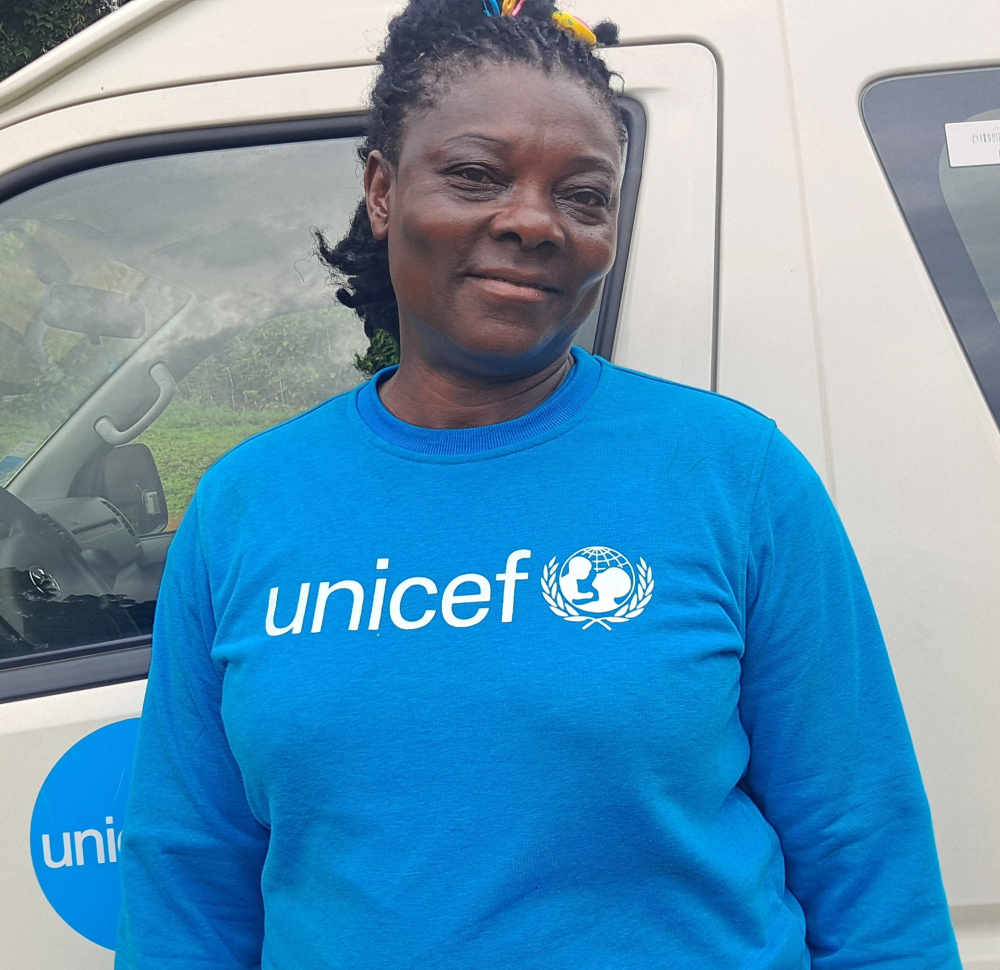
The 56-year-old lady in 2009 became the first female professional driver recruited by the United Nations System in Cameroon. Paving the way for other women by dint of hard work and perseverance.
In the bustling courtyard of the United Nations Children’s Fund, UNICEF Cameroon headquarters in Yaounde, amid the hum of air conditioners and the frantic pace of humanitarian planning, sits a white Land Cruiser. Behind the wheel is a woman whose presence is as commanding as the vehicle itself.
Louise-Françoise Ntoutou, 56, does not just drive; she navigates the complex intersection of gender, culture, and professional excellence. In a country where "professional driver" was, for decades, synonymous with "man."
The Woman In The Driver’s Seat
Ntoutou is a pioneer in the purest sense. In 2009, she became the first female professional driver recruited by the United Nations System in Cameroon. For 16 years, she has been the face of UNICEF’s mobility, ensuring that life-saving supplies and personnel reach the furthest corners of the nation. But her story did not begin with the blue and white logo of the UN. It began on the dusty, high-stakes highways of the public transport sector, fueled by a personal tragedy and an iron-clad will.
Gendarme’s Shadow
To understand Louise-Françoise Ntoutou, one must look at her hands - firm, steady, and disciplined. She attributes this to her lineage. Born in Edéa in Cameroon’s Littoral Region, she is the daughter of a legendary Gendarmerie Brigade Commander. Her father, a Bulu man from Ebolowa in the South Region, was a man of the 1960s - an era of strict hierarchy and military precision.
The very story of her existence is rooted in a mission of duty. During the UPC armed uprising, her father was sent to the village of Makondo near Edea to investigate. There, he met a Bassa woman - the only one in the village who spoke enough French to interpret for the colonial-era gendarme officer. That interpreter later became Ntoutou’s mother.
Apple Of Father’s Eye
Growing up as the first of seven children, Louise-Françoise was the apple of her father’s eye. He saw in her the "physique of a soldier." He didn’t see an ordinary girl; he saw a future officer. He pushed her toward the military, and in 1990, she nearly fulfilled that dream. She applied, passed the rigorous tests, and was selected for parachute training. But delays in call-up set in. While waiting eight months for her call-up in Ebolowa, destiny intervened in the form of a man from across the Atlantic.
The Uruguayan Connection
While the military training stalled, Ntoutou met Mario Niber Lucas Sartorio, a logger and former technician from Uruguay who had come to Cameroon in the 1970s to build the Songloulou hydro-dam. Sartorio was a man of machines, a logger who understood the language of engines and torque.
He fell in love with the gendarme’s daughter but made one firm request: she must choose the home over the barracks. Out of respect for her husband, Ntoutou turned her back on the military. A decision that broke her father’s heart and led to years of silent disappointment.
However, Sartorio gave her a different kind of weapon. He taught her to drive. Not just as a hobby, but as a craft. He bought her three cars for her errands, insisting she understand the mechanics of the road. It was a period of domesticity that, unbeknownst to her, was a long-term apprenticeship for a career that would one day sustain her.
The Widow’s Pivot
The year 2002 brought a devastating blow. Mario Sartorio died at the age of 53. Suddenly, the woman who had three cars and a comfortable life was a widow in a society that often marginalizes women without protectors. Ntoutou found herself at a crossroads. She had been trained as a stenographer - she could have sought a desk job - but the "spirit" of the road called to her.
Legend Of The Highway
In 2003, she did the unthinkable for a woman of her standing: she applied to drive public buses. She started with Buca Voyages, tackling the Yaoundé-Ebolowa line. She wasn’t driving small sedans; she was handling 30-seat Toyota Coasters and 35-seat buses.
For the next six years, Ntoutou became a legend of the highway. She moved from Buca to RIM Voyages, and then to JACO Voyages. She plied the most dangerous routes in the country: the Douala-Yaoundé "death road," the winding cliffs to Bafoussam, and the coastal stretches to Kribi. She was often the only woman at the bus terminals, surviving in a male-dominated world through sheer competence.
"Le Bus" Elite
By 2006, Yaoundé was modernizing its transit. A new company, Le Bus, was formed to handle mass urban transit with massive, 11-meter-long vehicles. They needed 150 workers, including drivers. Ntoutou applied and, true to her father’s disciplined genes, she was ranked the best among all the recruited drivers!
She was quickly promoted to Le Car, the elite division for long-distance travel. By now, the name "Louise-Françoise" was synonymous with safety and reliability. She was no longer just a "woman driver"; she was a professional who happened to be a woman. It was this reputation that caught the eye of the world’s most prestigious humanitarian organization.
The Secret Informants
In 2009, UNICEF Cameroon advertised for a driver. Unlike today’s digital portals, the application process required physical papers. Ntoutou submitted her dossier and went back to her bus.
What followed is a story that sounds like a spy novel. UNICEF didn’t call her for an interview for a year. Instead, they watched. They sent "mystery passengers" to buy tickets on her Le Car routes to Douala and Bamenda. These informants sat in her bus, watching how she handled aggressive drivers, how she navigated tropical downpours, and most importantly, how she treated her passengers.
They looked for the "soldier" in her - the discipline to stick to the rules when no one was watching. After a year of secret monitoring, they were satisfied. She wasn't just a driver; she was a diplomat of the road. She was invited for a formal test, crushed it, and was hired.
Breaking The UN Glass Ceiling
When Ntoutou walked into the UN Cameroon compound in May 2009, she entered a world that was physically and culturally unprepared for her. For 12 years, she was the only female driver in the entire United Nations System in Cameroon.
"I had to prove myself every day," she recalls. "Men are jealous of their domains. To be accepted, a woman must work three times harder." She became a curiosity. In every village the UNICEF convoy entered, crowds would gather not just to see the vaccines or the school kits, but to see the woman behind the wheel of the lead vehicle.
Paved The Way - For Others
She became a mentor by accident. Her success eventually paved the way for others. In 2021, the UN Office for the Coordination of Humanitarian Affairs (OCHA) finally hired its first female driver - a woman who had been a former bus-driving colleague of Ntoutou’s. By 2025, UNICEF hired a second woman for its Douala office. The door Ntoutou kicked open in 2009 was finally staying open.
Autonomy Of The "Free Woman"
Ntoutou is blunt about what it takes for a woman to succeed in her field. She speaks of "autonomy" and being "free." In her view, the professional driving life is incompatible with the traditional expectations placed on African women.
"If you have a partner who is jealous, or if you are still in the child-bearing years, this job will break you," she says. She argues that the professional woman driver must be mature and independent. Her own status as a widow, though stigmatized, gave her the radical autonomy needed to commit 100% to the road. She never remarried, choosing instead to be married to her mission.
The Gendarme’s Final Salute
Perhaps the most touching arc of Ntoutou’s life is her relationship with her father. For decades, he carried the weight of her "missed" military career. He saw her driving buses and feared she had wasted her potential.
But the UN recruitment changed everything. The prestige of the "Blue Flag" and the significant salary it commanded - far more than a military pension - finally won him over. Ntoutou spent the final years of her father's life taking care of him with the resources her UN career provided. When he passed away in her arms in 2019, he died not as a disappointed commander, but as a proud father of a woman who had reached the pinnacle of her own chosen field.
The Final Stretch
Today, at 56, Ntoutou is far from finished. While her military peers have long since retired, she laughs at the fact that she still has nearly a decade of service ahead of her before the UN retirement age of 65.
She remains a "great sports lady" at heart, carrying the spirit of the handball player who once dominated the courts of Yaoundé. Her legacy is written in the kilometers she has covered and the lives she has touched. She is no longer just a driver; she is a beacon of what is possible when a woman refuses to be sidelined by grief, gender, or age.
As she pulls out of the UNICEF compound for another mission, Louise-Françoise Ntoutou isn't just watching the road ahead. She is watching the rearview mirror, making sure the women coming up behind her have a clear path ...
Cet article complet est réservé aux abonnés
Déjà abonné ? Identifiez-vous >
Accédez en illimité à Cameroon Tribune Digital à partir de 26250 FCFA
Je M'abonne1 minute suffit pour vous abonner à Cameroon Tribune Digital !

- Votre numéro spécial cameroon-tribune en version numérique
- Des encarts
- Des appels d'offres exclusives
- D'avant-première (accès 24h avant la publication)
- Des éditions consultables sur tous supports (smartphone, tablettes, PC)






Commentaires