

Interview “CMC Will Help 10 Young Doctors Start Private Practice Annually”
- Par Kimeng Hilton
- 18 May 2026 20:57
- 0 Likes
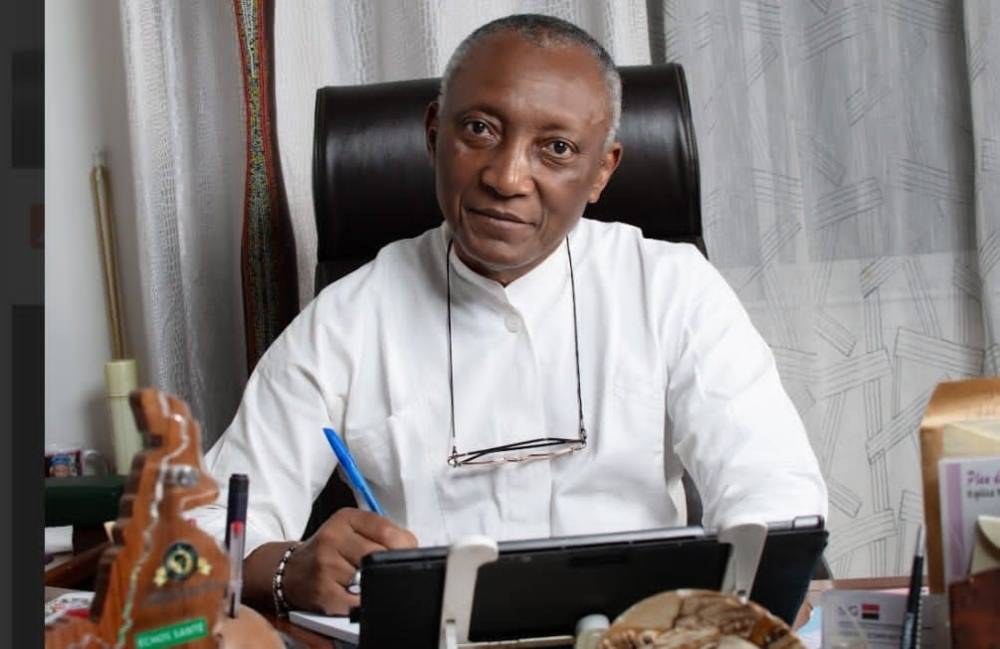
Dr Rodolphe Fonkoua, President of the Cameroon Medical Council, CMC.
The General Assembly of the National Council of the Medical Council of Cameroon took place in Bertoua from May 14-16, 2026. What were the highlights of this assembly?
Well, generally speaking, it wasn't a General Assembly of the Council; it was a Council Session. We took advantage of the very first Regional Assembly of the regional representation of the Cameroon Medical Council for the East Region to hold our Council Session there. So that was it. The first General Assembly of the East Region was being established, and the National Council wanted to hold its session in Bertoua as well.
What were the key points discussed during this session?
Well, the main point whenever the Council travels is first to listen to the grievances and the specific problems of that region. And we realized that there is a glaring lack of medical specialists in Eastern Cameroon, which nonetheless represents a quarter of the national territory!
In terms of surface area?
Right, in terms of surface area. And imagine, across this entire region, there are some specialties that don't exist at all. In total, there are only 31 specialists for the entire region. So for us, that was a huge revelation. It is a deficit that truly needs to be addressed quickly. That is the first major point.
The second major point: on the margins of our work, we decided to address the unemployment of young doctors, some of whom have been out of work for nearly five years since leaving school. We realized that doctors are not trained in entrepreneurship, so they are afraid to launch out on their own.
Therefore, the Council decided to launch a pilot study. We are going to try to support one young doctor in setting up a practice in each region every year. We will follow up and guide them for one or two years. If it succeeds, it could inspire others and encourage doctors to become entrepreneurs. So, that was another quite strong decision we made.
We conducted our usual Council business - reviewing applications for private practice setups, changes in geographical areas, and occupational medicine. That is a summary of the points we addressed.
Speaking of specialists in the East Region, which specialties are lacking the most?
In all areas. Because even if you calculate the ratio per number of inhabitants, we are very far from where we should be. It's a shame. Later, I will ask the regional representative to send me the exact list.
What I do know is that even for pediatricians - specialties where children need care - there is a glaring shortage. There are entire divisions where there isn't a single pediatrician, which is not normal.
That's a major gap!
Exactly. I can ask him to send me the exact statistics so I can make them available to you.
Given the specific nature of the East Region, how many specialists are needed at the bare minimum?
Well, logically, you know, this is what's frustrating. We calculate a standard ratio. The WHO (World Health Organization) calculates the ratio based on the number of inhabitants.
Based on the population?
Yes. But unfortunately, they do not take surface area into account. For example, you might have a village with only - let's say - 200 inhabitants, but it is 800 kilometers away from Bertoua. And within that distance, the nearest pediatrician is 400 kilometers away.
This means if a child gets sick there, they have to travel 400 kilometers to reach a pediatrician, which is unacceptable. To be fair, medical coverage needs to account for the population size, but also the geographical surface area.
Which the WHO does not take into account at the moment?
Exactly. Right now, it's based on population. If you look only at population, you could say the current number is sufficient. But it isn't, because it ignores the distance.
Because the settlements are scattered?
Exactly. So I believe that for specific extremes, we need to create a medical grid that factors in distance rather than just population size.
Let's talk about the integration of young doctors. I read somewhere that you mentioned 80% of young doctors are unemployed. Is that really true?
Roughly. Between 60% and 70%. Because for the past 5 years, the State - which is the biggest employer - is no longer hiring.
The State isn't hiring anymore. Why?
I believe it's due to IMF restrictions that prohibit the government, as part of its restructuring, from recruiting. Unfortunately, during this time, the population grows every year, and the needs are massive. That is one of the main reasons the State hasn't hired for 5 years.
Consequently, as soon as doctors get an opportunity, they leave. So combined with that, even those who do work, when you interview them, they tell you that as soon as they have an opportunity to earn better elsewhere, they will leave.
They leave. But between 60% and 70% of those unemployed haven't left yet.
But they are in the cities.
They are in the cities. And are these doctors trained in Cameroon, or are some trained abroad?
Well, every year we train about 750 doctors in Cameroon, and between 200 and 250 return from abroad. So about 1,000 doctors enter the market each year. Since the State isn't hiring, the rest relies on the private sector, but it cannot absorb everyone all the time. For example, I am in the private sector. I cannot hire two doctors every year if I already have the number of doctors I need. I cannot just create positions. So the solution isn't entirely the private sector.
Now, there was another option: settling doctors all in the private sector. Unfortunately, there is illegal medical practice. There are people who have nothing to do with medicine occupying the cities and neighborhoods everywhere. Those people need to be driven out and replaced with real doctors.
Who is going to drive them out?
I don't hold public authority. I can provide the authorities with the list of illegal structures, but enforcement is not up to us. That's why in the East - and this was also one of our resolutions - I met with the Governor and the Senior Divisional Officer for Lom and Djerem. They are ready to support the regional Cameroon Medical Council chapter in the fight against the illegal practice of medicine. So that is very good news, at least for the East.
Other regions need to have regional representations of the Council to fight illegal medicine. If we close all those structures, we can replace them by installing young doctors. That could be a solution.
I did a study in Douala. If we close all the illegal structures in Douala, we could absorb between 1,500 and 2,500 medical doctors. In Yaoundé, we could integrate between 500 and 700 doctors if we close all illegal structures.
So just by closing all illegal structures, we can place these unemployed youth - our children. We can place them. While waiting for the State to perhaps start hiring again. So without spending a single Franc, if the State helps us close all illegal structures, we can accommodate all these children. We must not forget that training a single doctor costs between 20 FCFA and 50 million FCFA.
During the seven years, yes.
We train them, we don't make money back, we don't utilize them, and they go elsewhere. So it is first and foremost a loss of money. The nation spends between 20 FCFA and 50 million FCFA to train a doctor, but we don't utilize them. We don't utilize them. And yet, the needs are enormous. The needs are enormous.
As we speak right now, how many young doctors are currently unemployed?
To give you an exact figure...
Roughly how many?
I can’t tell you. But let's say a huge number of them are leaving. Enormously.
Enormously!
To the West, to Europe. You hear about Canada. I was in the United States a month ago - no, less than a month ago. I met plenty of young medical graduates from the Université des Montagnes, etc., plenty of young people.
It was in Atlanta. That particular gathering was in Atlanta. But I am sure across the entire United States, I don't know how many they are. So there are many, many young children we train who are leaving. It's not good.
It's not good because what is the risk? The medical population, just like the general population, is aging. You know, people like us won't be here in a few years. And if those young people who left don't return - and they won't return - it means soon we will have a massive shortage of doctors. And that is not good.
Because others will retire.
Yes, because when they... Of course, for those who retire, there will be no one to replace them. Because the younger ones have gone to look for better opportunities elsewhere. That is the danger.
That is the danger. Let's talk about the support system to integrate young doctors. How much will that cost the Council approximately? And will it be a grant or a reimbursable loan?
No, they will have to pay it back. We will secure credits. We will set them up, monitor them, and implement a repayment schedule. It's not a plan where we just provide the money out of pocket, because we don't even have it. We have signed conventions with banks that are ready to support us.
They will be granted credits, but the Council will supervise these children in the beginning since they don't know how to manage a business, and we will set up a repayment plan.
Okay. And how much will it cost roughly for the 10 young doctors each year?
I can't give you an exact figure. It will depend on the city because we have to find a commercial space. Because we don't know how much renting will cost. We have to equip them, etc. However, we think that for a start, between 5 FCFA and 7 million FCFA per clinic should be more than enough.
Because looking back at my own experience, I didn't start with that much money to equip myself. Most of them are general practitioners. What do they need? An office, a few basic medical devices, etc. They start from there.
Anything else to add regarding this recent council meeting in Bertoua?
Well, it's true that we wrapped up on Saturday with an important meeting of the Medical Disciplinary Council. Several doctors appeared before this disciplinary board. There were sanctions.
How many were sanctioned?
Oh, roughly about 12 doctors.
For what reasons, generally speaking?
Medical errors
Thank you very much, Sir.
You're welcome...
Cet article complet est réservé aux abonnés
Déjà abonné ? Identifiez-vous >
Accédez en illimité à Cameroon Tribune Digital à partir de 26250 FCFA
Je M'abonne1 minute suffit pour vous abonner à Cameroon Tribune Digital !

- Votre numéro spécial cameroon-tribune en version numérique
- Des encarts
- Des appels d'offres exclusives
- D'avant-première (accès 24h avant la publication)
- Des éditions consultables sur tous supports (smartphone, tablettes, PC)






Commentaires