

A Tap, A Latrine, And Soap: Civil Society Demands Mandatory Water Infrastructure In New Schools
- Par Kimeng Hilton
- 16 Jun 2026 21:52
- 0 Likes
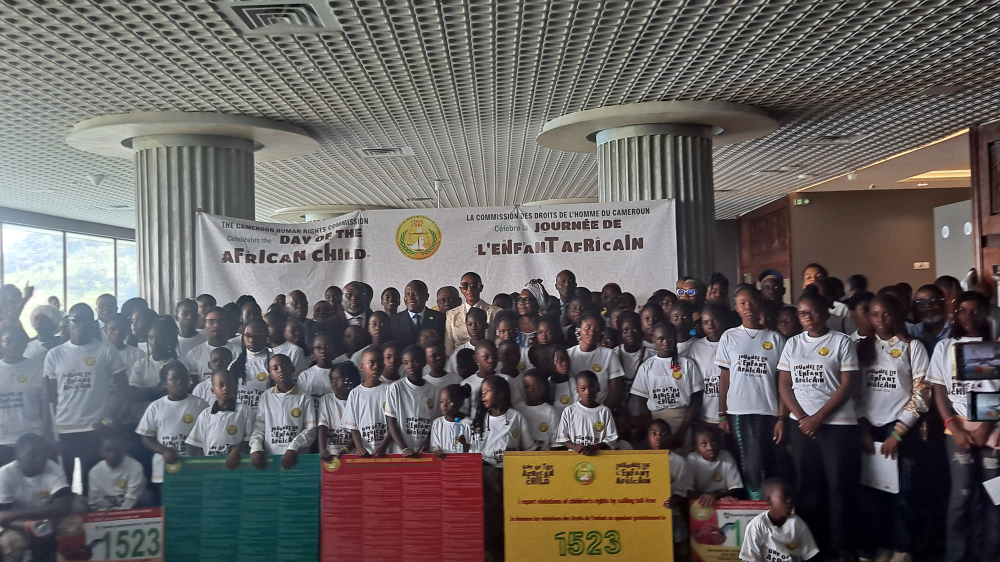
This was one of the appeals made in Yaounde on June 16, 2026 at the summit convened by the Cameroon Human Rights Commission. To mark the Day of the African Child.
Exactly a half-century after the historic 1976 Soweto, South Africa deadly youth uprising, the Cameroon Human Rights Commission, CHRC on June 16, 2026 in Yaounde convened a watershed commemorative ceremony. Bringing together senior government officials, international diplomats, United Nations dignitaries, and passionate youth advocates, the summit served as an urgent evaluation of the state of the African child.
Quieter, Deadly Battle
The baseline message of the day was clear: while the children of Soweto faced down Apartheid bullets to protect their right to learn, the children of 2026 face a quieter, yet equally deadly battle. Against infrastructural poverty, climate displacement, and an alarming spike in domestic violence.
Soweto Heirs
The morning began with an electrifying address by Miss Fadimatou Aboubakar, speaking as the official representative of African children. Aboubakar drew a direct line from her contemporaries to the generation of 1976, noting that 50 years later, the baton of conviction has officially been passed.
"Fifty years ago, in June 1976, children like us were marching in the streets of Soweto," Aboubakar declared. "They did not have weapons, they had notebooks. They did not have a written speech, they had a conviction: learning is a right, not a privilege."
Growing Up Paradox
Aboubakar highlighted the profound paradox of growing up as an African child in 2026. On one hand, she celebrated the dynamic strength of the continent’s youth - the largest generation Africa has ever seen - pulsing with creativity and innovation. On the other hand, she laid bare the systemic wounds holding them back: Millions of children still lack access to a decent classroom, young girls continue to be torn from their childhoods by early marriage and female genital mutilation, and boys are routinely trafficked into child labor instead of attending school.
Uncompromising Youth Demands
Refusing to treat the ceremony as a mere celebratory formality, Aboubakar issued three uncompromising, rights-based demands to the decision-makers in the room: An immediate end to a "two-tier" academic system that partitions children into well-funded, modern laboratories or roofless classrooms. She demanded respected, properly trained teachers and curricula taught in African languages that proudly reflect local history and heroes.
Comprehensive measures to shield children from exploitation and institutional indifference. "We are not asking you for perfection," she urged. "We are asking you for urgency." And true inclusion in the legislative, policy, and budgetary discussions that directly impact their futures. In a sharp critique of traditional political optics, Aboubakar stressed that youth should be integrated into public policy, "not for form, not for photos. Truly."
Human Toll Of WASH Deficits
The focus of the policy debates quickly shifted to the official 2026 continental theme: "Ensuring universal access to water, sanitation, and hygiene (WASH) for every child in Africa." Mr. Enama, President of the Cameroon Child Rights Civil Society Organizations Network, delivered a data-driven indictment of the continent's infrastructure. He observed that while children in 1976 died for the right to learn, children in 2026 are dying because they lack clean water, operating toilets, and soap.
The statistics presented by Enama paint a grim reality: One in three children in Africa lacks safe drinking water, and one in two lacks decent toilets. An astonishing 70% of schools across the continent lack basic soap for handwashing. More than 1,000 African children under the age of five die every single day from preventable diarrheal illnesses - a tragedy Enama noted could be eradicated by a simple tap, functional latrines, and soap.
Girls Most Affected
Enama meticulously broke down how water infrastructure dictates the arc of a child's entire life. For a 12-year-old girl, the absence of separate, private toilets at school means losing a full week of lessons every single month due to her menstrual cycle, a primary driver behind female dropout rates. For a 7-year-old boy, drinking contaminated river water means recurring illness, academic decline, and sometimes, early death.
"WASH is not a technical problem," Enama argued. "It is a problem of social justice. Accepting that a child learns without water or toilets is accepting cut-rate health, cut-rate dignity, and a cut-rate life."
Severe Regional Disparities
While Cameroon’s 1996 Constitution and subsequent environmental and water management regimes legally guarantee the right to clean water, execution remains heavily fractured by geography and income.
According to data cited from the World Health Organization (WHO), while 76% of urban Cameroonians enjoy access to safe drinking water, that number plummets to just 47% in rural areas. The deficit is especially severe in the North, Far North, and Adamawa regions, where infrastructure is remarkably thin.
Compounded By Economic Hardship
Furthermore, widespread economic hardship compounds the issue: with 37.5% of the population living below the poverty line, the commercial cost of water remains completely prohibitive for underprivileged households. Compounding this structural failure is a behavioral gap, with less than 30% of households actively practicing proper handwashing with soap.
To combat this, civil society issued an immediate four-part manifesto: Making a clean water point and gender-separate latrines an absolute prerequisite for building any new school. Moving away from failed top-down infrastructure models by training local artisans and building community water committees led by women and youth. Urging the government to treat school hygiene with the same financial urgency as commercial roadways. And reminding donors that every single dollar invested in WASH yields a four-dollar return in health and productivity.
Climate Change
Adding an international dimension to the crisis, Mrs. Casimira Bange, representing UNICEF Cameroon, warned that climate change is fundamentally transforming the nature of childhood. Bange observed that those who contribute the least to global emissions are paying the highest price, with vulnerable children bearing the brunt of environmental degradation.
UNICEF detailed a reality where shifting weather patterns alter how children eat, learn, play, and fall ill. Extreme droughts force young girls to spend hours seeking distant water sources instead of studying, while intense flooding renders infrastructure completely inaccessible to children living with disabilities. When environmental disasters strike, existing systemic inequalities dramatically widen.
Child Welfare On The Backburner
Bange strongly cautioned against a growing global trend to put child welfare on the backburner during tough economic times. Marking UNICEF's 80th anniversary since its post-war founding in 1946, she re-anchored the agency's commitment to underrepresented youth.
"Child rights are not a luxury reserved for periods of prosperity," Bange remarked. "They are precisely made for periods of uncertainty, to protect those who have the least power."
Domestic Violence
Beyond infrastructural hazards, the summit turned its attention toward a dark and rising tide of targeted domestic violence against children within Cameroon. Professor James Mouangue Kobila, President of the CHRC, delivered an emotional address regarding an alarming national surge in infanticide, filicide, and severe intra-family abuse.
Sharp Increase
To illustrate this dangerous trajectory, Professor Kobila made public the commission's internal metrics documenting cases of parental neglect, trafficking, physical abuse, and sexual violence: Some 59 cases of extreme child violations were documented in Cameroon in 2021, but the number jumped to 151 cases in 2024. This sharp increase over a three-year window prompted Kobila to call on the judiciary and administrative authorities to apply an uncompromising policy of absolute zero tolerance.
"Faced with these abject acts and the killing of our children, the Cameroon Human Rights Commission calls on competent authorities to reverse this deadly spiral," Kobila stated emphatically. "To destroy the life of a child is not a mere news item; it is a crime against humanity."
Baby Mathys’ Mother's Somber Testimony
Putting a human face to these sterile statistics was the sobering, live testimony of the mother of six-year-old Mathys Ouandji. Mathys was brutally stabbed to death and suffered a severed arm on May 10, 2025, in the Ngoa-Ekelle neighborhood of Yaoundé by an intruder named Dagobert Nwafo, known locally as "Uncle Black."
Gory Tale Mixed With Sobs
The mother recounted the agonizing moments of receiving the emergency call while shopping at the Mokolo market, rushing to the military garrison, and discovering that her youngest child had succumbed to multiple stab wounds while his older siblings narrowly escaped by hiding. Providing a grim resolution to the tragic timeline, she noted that in March 2026, Nwafo was officially sentenced to death by a firing squad and handed a 500 million FCFA fine.
"Today justice has been served," she told the quiet auditorium. "I cannot say we are happy, but we are satisfied with the justice. All you want is for justice to be done."
The Roadmap To 2030
The summit concluded with a unified statement of intent from the United Nations system, represented by the proxy for Resident Coordinator Siaka Coulibaly. The UN reaffirmed its operational alignment with Sustainable Development Goal 6 (Clean Water and Sanitation) and Goal 3 (Good Health and Well-being), pledging to aggressively fund climate-resilient water grids across Cameroon’s rural interior.
State Performance Metrics
As the delegates departed, the focus turned toward the state's performance metrics under the National Development Strategy (NDS30). With Cameroon legally committed to achieving 100% clean water access in urban hubs and 85% in rural communities by 2030, the commitments made at Mont Fébé will be measured not by the...
Cet article complet est réservé aux abonnés
Déjà abonné ? Identifiez-vous >
Accédez en illimité à Cameroon Tribune Digital à partir de 26250 FCFA
Je M'abonne1 minute suffit pour vous abonner à Cameroon Tribune Digital !

- Votre numéro spécial cameroon-tribune en version numérique
- Des encarts
- Des appels d'offres exclusives
- D'avant-première (accès 24h avant la publication)
- Des éditions consultables sur tous supports (smartphone, tablettes, PC)






Commentaires