
Health Partnership: WHO, Cameroon Launch 2025–2030 Cooperation Strategy
- Par Kimeng Hilton
- 30 Sep 2026 22:10
- 0 Likes
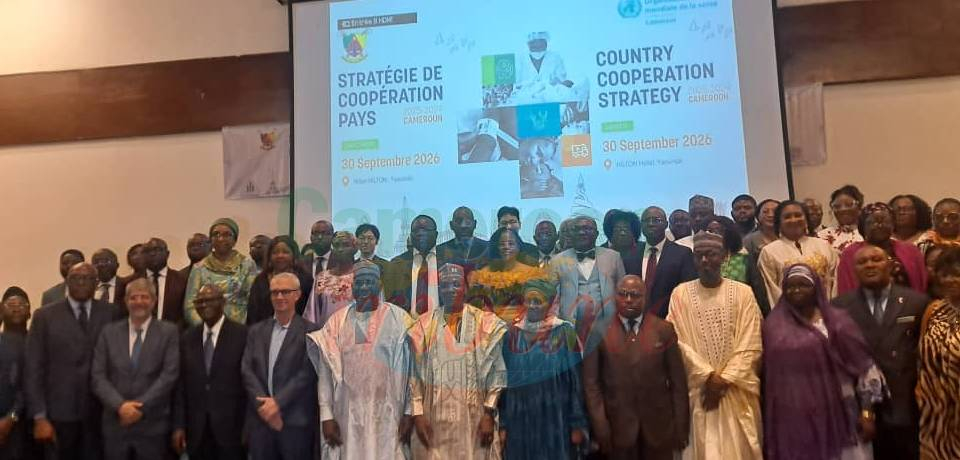
Presented in Yaounde on September 30, 2026, the plan aligns directly with Cameroon’s National Development Strategy, SND30 and the Health Sector Strategy 2020–2030.
The Ministry of Public Health, alongside the World Health Organization, WHO and the United Nations system, officially presented the WHO Country Cooperation Strategy, CCS for Cameroon for 2025–2029.
Tangible Health Outcomes
The high-level handover ceremony in Yaoundé on September 30, 2026 brought together cabinet ministers, diplomatic representatives, multilateral development agencies, local authorities, civil society actors, and academic experts.
Addressing delegates on behalf of the Government, the Minister of Public Health, Dr. Manaouda Malachie, emphasized that the multi-year blueprint must serve as an operational tool to deliver tangible health outcomes to everyday Cameroonians across all ten regions.
Key Strategic Pillars (2025–2029)
The newly adopted cooperation strategy aligns directly with Cameroon’s National Development Strategy, SND30 and the Health Sector Strategy 2020–2030. Designed through broad multi-sectoral consultations, the framework structures WHO technical support and partner interventions around four overarching public health priorities:
Expanding Medical Services
Enhancing institutional leadership, planning, financial management, and real-time health information collection to guide evidence-based decision-making. Expanding essential medical services, strengthening local health workforces, securing drug supply chains, and reducing financial barriers for vulnerable populations.
Institutionalizing early-warning surveillance mechanisms and cross-border responses to manage epidemic threats through an integrated "One Health" lens. And addressing broader environmental, nutritional, and lifestyle factors while mitigating the growing burden of non-communicable diseases such as hypertension, diabetes, and cancer.
Life-Saving Action
Dr. Bagayoko Magaran Monzon, WHO Representative for Cameroon, underscored that while formal validation of the strategy was concluded in mid-2025, the true benchmark of success lies in execution. "Having quality plans is one thing, but ensuring their implementation is another—and that is where the main challenge lies... A strategy only takes on its full meaning when translated into concrete improvements in the lives of the general population," Dr. Bagayoko said.
He noted that declining official development assistance (ODA) requires partners and the state to optimize available resources by focusing strictly on priority interventions, institutional capacity transfer, and the multi-sectoral "Health in All Policies" paradigm.
Predictable Domestic Financing
Speaking on behalf of the UN Resident Coordinator, the UN leadership called for structured coordination under the "UN as One" approach to eliminate operational overlaps and leverage inter-agency synergies. The UN representative highlighted that long-term health security, emergency preparedness, and universal coverage require sustainable domestic resource mobilization.
Cet article complet est réservé aux abonnés
Déjà abonné ? Identifiez-vous >
Accédez en illimité à Cameroon Tribune Digital à partir de 26250 FCFA
Je M'abonne1 minute suffit pour vous abonner à Cameroon Tribune Digital !

- Votre numéro spécial cameroon-tribune en version numérique
- Des encarts
- Des appels d'offres exclusives
- D'avant-première (accès 24h avant la publication)
- Des éditions consultables sur tous supports (smartphone, tablettes, PC)








Commentaires