

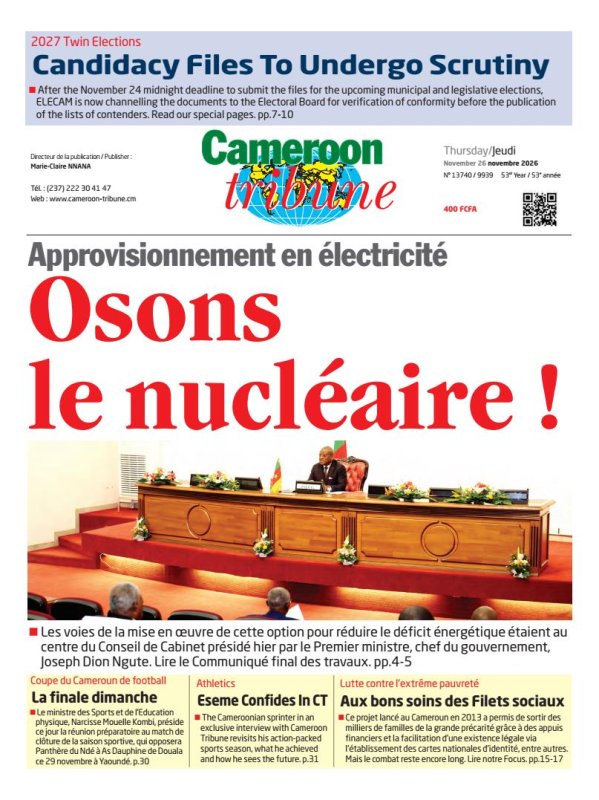
Below is a press release following the Cabinet meeting of Wednesday 25 November 2026.
“The Prime Minister, Head of Go vernment, His Excellency Joseph Dion Ngute, chaired a Cabinet mee ting on Wednesday 25 November 2026 at 10.00 am in the Auditorium of his Office. The meeting was at tended by Ministers of State, Minis ters, Deputy Ministers and Secreta ries of State. The following items featured on the agenda: 1. a statement by the Minister of Water and Energy on ‘The stakes and challenges involved in intro ducing the civil nuclear power op tion into Cameroon's energy mix’; 2. a statement by the Minister of Scientific Research and Innovation on ‘The conditions and prerequi sites for establishing a civil nuclear power programme’; 3. a statement by the Minister of Forestry and Wildlife on ‘The foun dations and guidelines for streng thening the strategic manage ment of international cooperation in the forestry sub-sector’; 4. Miscellaneous. Following the Head of Government’s introductory speech, the Minister of Water and Energy indicated that Cameroon's energy mix relies on hydropower (66%), thermal power (31%) and solar energy (3%). This energy mix makes our country vul nerable to hydrological fluctuations, at a time when demand is increasing steadily as a result of population growth, urbanization, and the ex pansion of industrial and mining ac tivities. With this in mind, the Minister pre sented nuclear power as a strategic option for diversifying production sources and strengthening national energy sovereignty. He particularly highlighted its advantages in terms of power generation capacity, long- term cost management, reduced de pendence on imported fuels, and lower greenhouse gas emissions. He nevertheless stated the chal lenges associated with this tech nology, particularly the stringent nuclear safety and security requi rements, the management of spent fuel and radioactive waste, the scale of the required investments, imple mentation deadlines, and the avai lability of specialized skills. To this end, he pointed out that the implementation cycle for a conven tional nuclear power programme lasts, on average, fifteen years. He also mentioned the option of Small Modular Reactors (SMRs), with a ge nerating capacity ranging from 10 to 300 MW and an estimated construction period of four years, although their technical and com mercial maturity must still be confir med. For her part, the Minister of Scientific Research and Innovation pointed out that the governance of civil nu clear energy is based on a set of in ternational legal and institutional instruments designed to guarantee the peaceful use of nuclear energy, under the auspices of the Interna tional Atomic Energy Agency (IAEA). She stated that cooperation between Cameroon and this organization forms part of a National Framework Programme (NFP), including the one covering the 2024–2026 period. She outlined the achievements of this programme, particularly in the health, agriculture, livestock farming, nu trition, environment and industry sectors. The Minister nevertheless clarified that these achievements relate exclusively to non-energy ap plications of nuclear technology, as our country currently has neither a nuclear power station nor a research reactor, and has not yet formally in corporated this option into its na tional energy strategy. After outlining the continental me chanisms for cooperation and regu lation, she presented the national legal and institutional framework, notably the Law of 19 July 2019 laying down the general framework for radiological and nuclear safety, civil liability and the application of safeguards, as well as the reorganization of the Radiological Safety and Nuclear Security Authority (AS RAN), which took place on 19 No vember 2024. Discussing the prerequisites for launching a nuclear power pro gramme, she emphasized the need for a phased approach, in line with the IAEA’s recommendations, with the first stage being the completion of an in-depth feasibility study. This study will make it possible to assess the project's strategic relevance, technical and economic viability, sa fety and radiation protection requi rements, as well as the institutional and human resource capacities nee ded. She also emphasized the need to secure sites, develop specialist skills, mobilize national expertise and es ...
Cet article complet est réservé aux abonnés
Déjà abonné ? Identifiez-vous >
Accédez en illimité à Cameroon Tribune Digital à partir de 26250 FCFA
Je M'abonne1 minute suffit pour vous abonner à Cameroon Tribune Digital !

- Votre numéro spécial cameroon-tribune en version numérique
- Des encarts
- Des appels d'offres exclusives
- D'avant-première (accès 24h avant la publication)
- Des éditions consultables sur tous supports (smartphone, tablettes, PC)


Reactions
De la meme catégorie

Conseil électoral: Jour de prestation de serment
- 26 Nov 2026 07:18
- 0 likes




Commentaires