

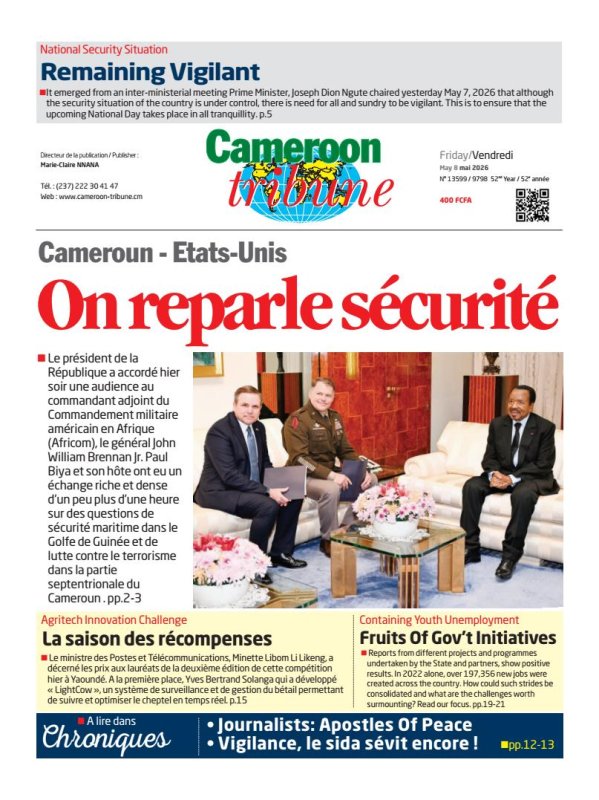
Journalists: Apostles Of Peace
- Par Eldickson Agbortogo
- 08 May 2026 08:06
- Likes
On May 3, 2026 media practitioners nationwide and across the board celebrated World Press Freedom Day under the theme; “Shaping a Future at Peace: Promoting Press Freedom for Human Rights, Development, and Security”. The Day celebrated annually, highlights the fundamental principles of media freedom, evaluates its state worldwide, defends media independence, and honours journalists who lost their lives in the line of duty. Proclaimed by the UN General Assembly in 1993, the Day marks the anniversary of the Windhoek Declaration, which advocated for free and pluralistic media. Each year, UNESCO organizes global conferences that bring together journalists, media professionals, and legal experts to discuss challenges such as safety, sustainability, and technological impacts, including artificial intelligence. This year’s World Press Freedom Day Global Conference “Shaping a Future at Peace” that took place from May 4 to 5, 2026 in Lusaka (Zambia), offered a critical moment to reaffirm freedom of expression both as a normative and empirical lever for shaping the future of information societies. The event that brought together press freedom advocates and digital rights communities came at a time when the boundaries between journalism, technology, civic space, and human rights are increasingly intertwined. In Cameroon, several activities were organised on May 3, 2026 in the different Regions by media practitioners to raise awareness regarding attacks on media independence and remind government of the need to uphold its commitments to press freedom. Reflections among media professionals on how they can better carry out their duties took centre stage during celebrations. From the brainstorming exercise, it emerged that journalists have a very primordial role to play as far as the quest for peace is concerned. They can serve as apostles of peace by analysing conflict, de-escalating tensions, and promoting nonviolent solutions rather than just reporting the raw, often inflammatory facts of a crisis. In a complex environment where misinformation and polarization are common, their role requires a departure from traditional day-to-day superficial reporting of events, to a down-to-earth analysis of the root causes of the crisis. This requires a rigorous verification of the information sources especially on social media in order to combat fake news and propaganda that can fuel violence. As apostles of peace, instead of merely reporting that a violent event occurred, journalists should be able to explain the underlying socio-political, historical, and economic causes in order to help the public better understand the raison d’être of the crisis. Focus on positive stories and the human impact of the crisis to encourage empathy, dialogue, and a sense of shared humanity among conflicting parties. Creating platforms where diverse voices can be heard and promote reconciliation rather than taking sides are major weapons journalists must use to help bring or maintain peace in a community. Being able to publish unbiased information, does not only give journalists the opportunity to hold leaders and institutions accountable, but also strengthen societies and foster social cohesion. Journalists therefore, have the powers to tackle exclusion, help prevent violence and contribute to foster peace. In addition to informing people, journalists can shape and spread values, defuse tensions, counter hate-speech, provide an array of different views and opinions. In Regions torn apart by conflict, where mistrust runs deep and violence seems endless, much is expected from journalists, armed with nothing but their commitment to truth and ethical reporting. Through accurate, impartial and non-tribal reporting, journalists can help transform hostile environments into spaces where dialogu...
Cet article complet est réservé aux abonnés
Déjà abonné ? Identifiez-vous >
Accédez en illimité à Cameroon Tribune Digital à partir de 26250 FCFA
Je M'abonne1 minute suffit pour vous abonner à Cameroon Tribune Digital !
- Votre numéro spécial cameroon-tribune en version numérique
- Des encarts
- Des appels d'offres exclusives
- D'avant-première (accès 24h avant la publication)
- Des éditions consultables sur tous supports (smartphone, tablettes, PC)





Commentaires