

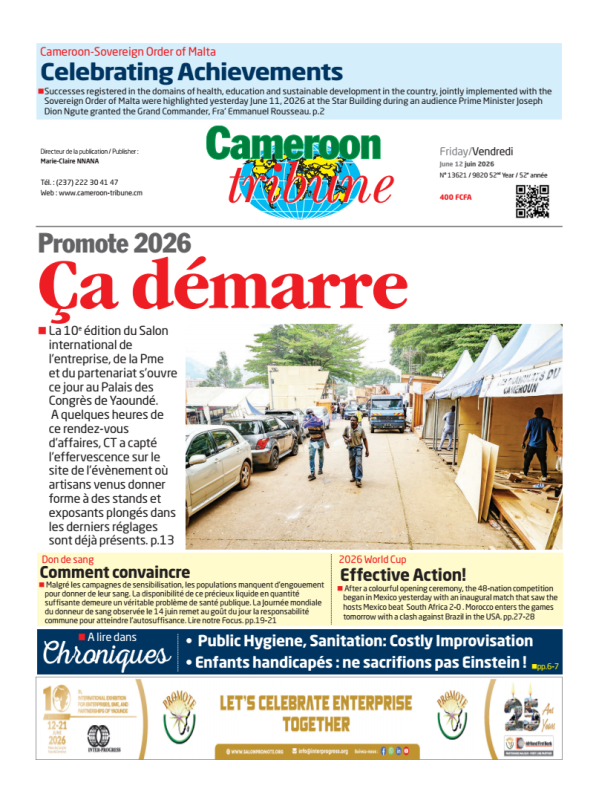
Public Hygiene, Sanitation: Costly Improvisation
- Par Brenda YUFEH
- 12 Jun 2026 05:50
- Likes
When basic public amenities are lacking, people are forced to improvise, and this gives rise to one of the gravest environmental and public health threats in the areas of hygiene and sanitation. In many towns and cities across the country, it is not uncommon for residents to find themselves having to walk through human waste on major roads and at street corners. This is the direct consequence of public amenities being absent from daily life. Amongst the most glaring deficiencies are a severe shortage of public conveniences and a lack of litter bins. In their absence, residents must resort to daily workarounds that undermine public health, harm the environment, and erode human dignity. In Yaounde, a city of more than 4.1 million residents, the majority of public amenities are located in the administrative quarters, to the detriment of markets and transport hubs. Douala, the capital of the Littoral Region with a population exceeding 3.8 million, fares little better and is not without its own challenges. In busy areas such as the Mokolo quarter and the Central Market in Yaounde, or at motor parks in Douala, public urination and defecation routinely occur in alleyways, behind stalls, and along drainage channels. Where facilities are absent, private alternatives fill the void at a financial cost. Traders and commuters may be required to pay between FCFA 100 and 200 for the opportunity to use lavatories in bars, restaurants, or petrol stations, and even then only if they are granted admission to the premises. At Yaounde Central Market, where traders begin arriving at around 5:00 a.m., the nearest public convenience is roughly 800 metres from the entrance. It is privately run and does not open until 7:00 a.m. By 6:30 a.m., the pathway behind the textile section is saturated with the acrid smell of urine. The walls are stained. Vendors keep bottles of water to clean their hands, though not their stalls. Bus stations exhibit the same pattern. At the Mvan and Olembe motor parks, hundreds of travellers wait for hours. There are no lavatories within most of the bus stations, and travellers consequently resort to using the perimeter fences to answer nature’s call. After dark, public spaces pose a different kind of risk, particularly for women. At Mokolo Market, for instance, some night-time vendors prefer to wait until after 11:00 p.m., when customer numbers have dwindled, before relieving themselves on a poorly lit street behind the market known to be an open defecation site. There, they must contend with the absence of lighting, privacy, and security. Little wonder, then, that police reports record several cases of assault near well-known open defecation sites. Public litter bins are rarer still. In most cities across the country, trash bins are virtually non-existent beyond Council premises. The result is an urban landscape in which neither waste nor human needs are formally catered for. With few, if any, bins on the streets, at taxi ranks or in markets, rubbish is discarded wherever people happen to be. Plastic water sachets, takeaway wrappers and food waste pile up on pavements. These coping strategies contribute to the spread of disease. Cholera, typhoid and diarrhoeal illnesses persist where human waste contaminates the soil and water sources. Filthy streets signal that littering is acceptable, and children grow up regarding it as normal. The lack of toilets and bins does not remove human need; it merely displaces it onto streets, gutters and rivers. Until such amenities are provided and properly maintained, the health and liveability of Cameroon’s urban centres will remain compromised. Hygiene and sanitation are not abstract development goals. They are measured in the metres walked to find a lavatory, in the coins paid to use a private latrine, and in the odour that lingers on a street corner after rainfall. Their absence is not neutral. It compels behaviours that degrade health, the environment and civic life. A city reveals what it thinks of its people by where it permits them to urinate, where it asks them to dispose of their waste, and what it expects them to endure in public. Human dignity is not an abstraction to be debated in conference halls; it is concrete. It is the door that locks, the water that runs, and the bin that...
Cet article complet est réservé aux abonnés
Déjà abonné ? Identifiez-vous >
Accédez en illimité à Cameroon Tribune Digital à partir de 26250 FCFA
Je M'abonne1 minute suffit pour vous abonner à Cameroon Tribune Digital !

- Votre numéro spécial cameroon-tribune en version numérique
- Des encarts
- Des appels d'offres exclusives
- D'avant-première (accès 24h avant la publication)
- Des éditions consultables sur tous supports (smartphone, tablettes, PC)









Commentaires