

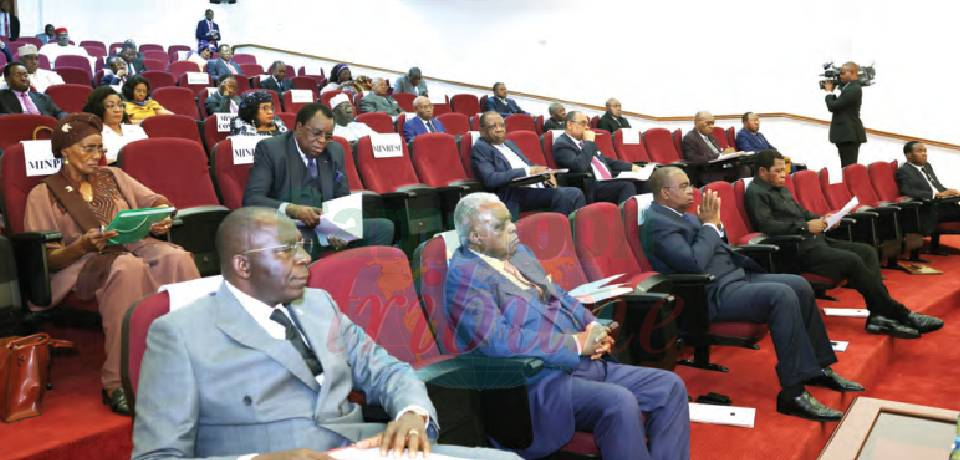
Below is a press release following Yesterday’s Cabinet meeting.
“C haired by the Prime Minister, Head of Government, His Ex cellency Joseph Dion Ngute, a Cabinet Meeting was held on Thursday, 27 August 2026, at 10.00 a.m. in the auditorium of the Prime Minister's Office. The meeting was attended by Ministers of State, Ministers, Ministers Delegate, and Secretaries of State. The following items featured on the agenda: 1. Statement by the Minister of State, Minister of Higher Education on "a re view of the 2025-2026 academic year and strategic guidelines to ensure a successful start of the 2026-2027 aca demic year"; 2. Statements by the Ministers of Basic Education, and Secondary Education on "the evaluation of the previous school year and measures taken to op timise the start of the 2026-2027 school year; 3. Statement by the Minister of Em ployment and Vocational Training on "developments during the 2025/2026 training year and prospects"; 4. Report by the Minister of Small and Medium-Sized Enterprises, Social Eco nomy and Handicrafts on "the procee dings of the 9th edition of the interna tional handicrafts exhibition of Came roon". In his opening statement, the Head of Government expressed his deep sorrow at the recent tragic events, particularly the landslide at a gold mine near the Cameroonian border, which resulted in the deaths of several of our compatriots. The Prime Minister also deplored the particularly deadly road traffic accidents recorded recently, as well as the resur gence of crimes committed against wo men, particularly by persons with whom they had close ties or in whom they had placed their trust. In memory of our fellow citizens who tragically lost their lives in these various circums tances, the Meeting observed a minute's silence. Taking the floor, the Minister of State, Minister of Higher Education, stated that the 2025-2026 academic year unfolded without any major disruption across all components of the sub-sys tem, namely State universities, private higher education institutions, public institutions with special status, and in ternational institutions. For the 2026-2027 academic year, which is due to begin on 5 October 2026, the main priorities will focus on strengthening teaching, research and support for development. With regard to education, the focus will be on rebalancing the national trai ning provision in favour of technological and vocational courses, with a view to directing more students towards fields directly linked to the growth sectors of the real economy. Particular emphasis will also be placed on promoting peda gogical innovation and the application of knowledge by establishing appro priate links between academic and prac tical training. As regards academic research, the an nounced priorities are aimed, in parti cular, at strengthening excellence in the generation of fundamental and ap plied knowledge, while paying greater attention to its capacity to address the real needs of national development. In terms of support for development, the coming academic year will be marked by the continued implementation of the student-entrepreneur status, with a view to creating more favourable conditions for graduates to set up bu sinesses, and, of the "university-busi ness" concept, aimed at sustainably establishing the University as a genuine hub for the -creation of value and wealth. Speaking next, the Minister of Basic Education stated that the 2025-2026 school year was hitch-free from both an administrative and educational pers pective, with a national syllabus cove rage rate of approximately 91.75 %. The results recorded during the 2026 examination and competitive exami nation session show satisfactory pass rates, namely 88.46% for the Certificat d'Etudes Primaires (CEP), 94.40% for the First School Leaving Certificate (FSLC), and 94.41 % for the Common Entrance Examination (CEE). Among the measures that contributed to these results were, in particular, the allocation of operating grants to go vernment schools, accompanied by the provision of the minimum package, as well as the awarding of grants to private nursery and primary schools. Special measures were also taken to ensure the smooth running of the school year in regions affected by security challenges. Furthermore, 3,379 new teachers were recruited and deployed across the country. With regard to the start of the next school year, scheduled for 7 September 2026, funding has been made available to the administrative authorities to oversee and ensure the smooth running of operations. Preparatory work has also resulted in the publication of the official list of school textbooks and the calendar of activities. As part of the clean-up process under way, 803 unauthorised schools have been closed. In her statement, the Minister of Se condary Education stated that the main initiatives undertaken during the 2025- 2026 school year focused, in particular, on strengthening the transfer of re sources to Regional Councils, awarding grants to private schools, and optimising the monitoring and evaluation of tea ching and educational support through the use of innovative digital tools. Emphasis has also been laid on impro ving students' academic performance in regions where results remain low, as well as on continuing the digitalisa tion of teaching, notably through the procurement of interactive whiteboards and the construction of smart class rooms. Furthermore, measures have been taken to address emerging social problems in schools, particularly drug use and gender-based violence. With regard to the examinations and competitive examinations for the 2026 session, the pass rates stood at 63.95% for examinations organised by the Di rectorate of Examinations and Compe titive Examinations (DECC), 48.24% for those administered by the Office du Baccalauréat du Cameroun (OBC), and 67.88% for certification assessments organised by the General Certificate of Education Board (GCE Board). Ahead of the start of the new school year, the Minister of Secondary Educa tion intends to continue implementing the inclusion programme and to press ahead with the reform of teacher trai ning, as well as that of technical and vocational education. The automation of operations and the ongoing digitali sation of teaching and processes will also feature among the priorities. Subsequently, the Acting Minister of Employment and Vocational Training outlined the key developments that had taken place during the 2025-2026 training year, structured around three main areas. The first focuses on diversifying the range of training on offer by-increasing the number of private institutions of fering specialisations more closely ali gned with value chains and sectors with high potential for job creation. This development stems, in particular, from a rationalisation of the training landscape aimed at better aligning the specialisations on offer with the needs of local areas and the requirements of economic regions. Emphasis has also been laid on modernising public training provision through structural investments carried out with the support of deve lopment partners. In this regard, parti cular mention was made of the ongoing construction of the Sector-Specific Vo cational Training Centres in Douala and Edea, as well as the recently commenced refurbishment of the Rapid Vocational Training Centre for Industrial Trades in Pitoa. In the same vein, priority is being given to funding mechanisms geared towards economic demand, through initiatives such as the Project to Support the Development of Secondary Educa tion and Skills for Growth and Employ ment (PADESCE) and the Project to Support the Promotion of Ent...
Cet article complet est réservé aux abonnés
Déjà abonné ? Identifiez-vous >
Accédez en illimité à Cameroon Tribune Digital à partir de 26250 FCFA
Je M'abonne1 minute suffit pour vous abonner à Cameroon Tribune Digital !

- Votre numéro spécial cameroon-tribune en version numérique
- Des encarts
- Des appels d'offres exclusives
- D'avant-première (accès 24h avant la publication)
- Des éditions consultables sur tous supports (smartphone, tablettes, PC)







Commentaires