

Notes Of Hope, Lyrics Of Power: Inside The Song That’s Empowering Millions
- Par Kimeng Hilton
- 18 Jan 2026 17:16
- 0 Likes
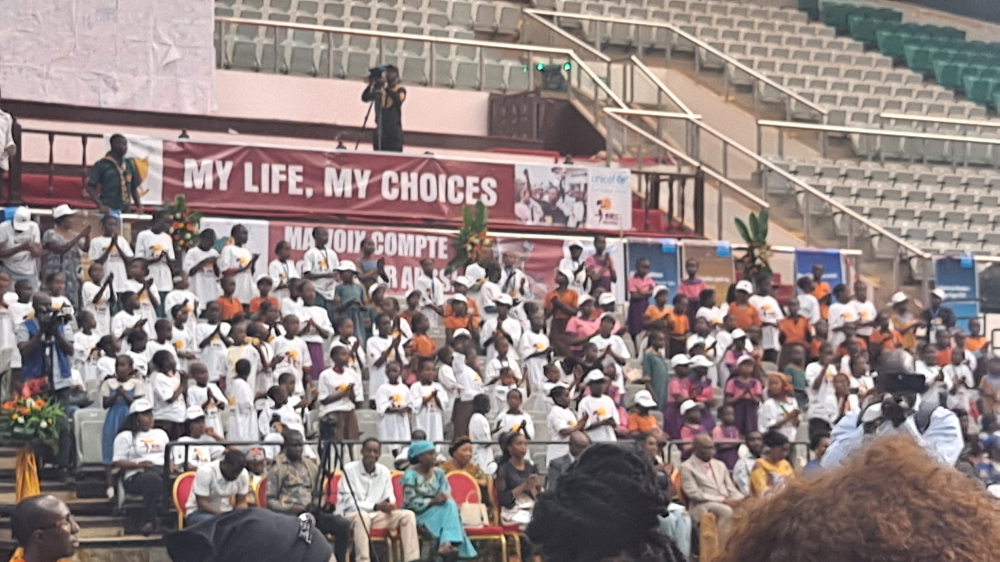
Adopted at last year’s National Caravan and the First National Forum on Girls’ Rights, the anthem was released on January 16, 2026 by the United Nations Children’s Fund, UNICEF.
The sun beats down on the dusty roads of Maroua in the Far North Region of Cameroon. Then travels across the lush highlands of Bamenda in the Northwest. And finally settles in the bustling, humid streets of Douala. The geography changes, the languages shift from French to English, Fulfulde and Bassa, but the rhythm remains the same. It is a heartbeat, a pulsating declaration of intent that began as a whisper. But has since erupted into a roar. It is the sound of six million girls refusing to be silenced.
New Visual Face
On January 16, 2026, in the Cameroonian capital, Yaounde, this rhythm found a new visual language. The United Nations Children’s Fund, UNICEF Cameroon announced the official release of the music video for the Girls’ Movement Anthem. But to call it merely a music video is to undersell the seismic cultural shift it represents. It is a vibrant symbol, a manifesto set to melody, and a clarion call for a generation that has decided they will no longer let others decide for them.
Infectious Chorus
The anthem, carried by an infectious chorus - “Allez, allez, allez plus haut” (Go, go, go higher) - has already permeated the airwaves of the nation. It has echoed in schoolyards, accompanied choreographed marches during the National Caravan, and provided the soundtrack for the First National Forum on Girls’ Rights.
Now, with the release of the official video produced by Kanao Entertainment and Mr. Tcheck, the movement has a face. It is the face of a girl from Adamawa dreaming of becoming a Medical Doctor, a girl from the Littoral visualizing herself as an engineer, thousands of girls looking into a camera lens and seeing not a subject of pity, but a force of nature.
The Sound Of A Generation
The video opens not with a lecture, but with energy. It is a product of the “I Am Music” programme, a creative sanctuary described as a space led by and for young people. This distinction is vital. For too long, the narratives surrounding African girls have been crafted by well-meaning outsiders - international organizations, government officials, or NGOs - who speak about them, rather than listening to them. The “I Am Music” programme flips this dynamic. The musicians, the singers, and the visionaries behind this track are young Cameroonians who created the soundtrack of their own lives.
Essence Of Project
Nadine Perrault, the UNICEF Representative in Cameroon, captures the essence of the project perfectly: “The Girls’ Movement Anthem carries a luminous message: that of girls who believe in their potential, who dare to dream higher, and who remind us that their voices are a collective force. This video echoes their energy, their courage, and their vision.”
In the frames of the video, we see the diversity of the Cameroonian experience. Girls from the 10 regions don traditional attire and modern school uniforms, standing against backdrops that range from urban concrete to rural savannahs. They are not passive observers; they are active participants, stamping their feet, clapping their hands, and raising their voices. When they sing, “Allez plus haut,” it is not just a suggestion; it is a command to the universe.
Their Voices, The Song
Consider the story of Djamilatou Yaya, a Junior Member of Parliament from the Adamawa Region. She is a young woman positioned at the intersection of tradition and governance. For her, this song is more than a pop anthem; it is a spiritual and political tool. “This song is more than an anthem: it’s our call for love and change,” she says. “It gives us wings.” In a country where young women often face heavy societal pressures, the metaphor of wings is profound. It speaks of elevation, of rising above the smog of low expectations, and of the freedom to soar without asking for permission.
Then there is Aïcha, a girl met during the Caravan whose story mirrors millions of others. “When I listen to this song, I hear messages that give us strength,” she shares. “It reminds us that we can dream higher and believe in ourselves.” In a world that often tells girls to shrink themselves, to be quiet, to be satisfied with less, Aïcha’s words are a radical act of self-preservation. The song acts as an auditory shield against the negativity of the world.
A Journey Across The Nation
To understand the weight of this anthem, one must look back to the summer of 2025. From June 27 to August 2, 2025, the Girls’ Movement Caravan embarked on a daunting logistical mission: to travel through all 10 administrative regions of Cameroon.
The caravan was not a parade; it was a listening tour. It was a mobile forum that turned town squares into safe spaces. UNICEF and its partners - ranging from the Ministry of Women’s Empowerment and the Family (MINPROFF), to UN Women, Plan International, and the Embassy of Japan - went directly to the source. They didn’t ask girls to come to the capital; they went to Bertoua, Maroua, Bamenda, and Bafoussam.
Over 5,000 Girls Consulted
The result was an overwhelming outpouring of testimonies. Over 5,600 adolescent girls were consulted. Their voices, often isolated in rural villages or crowded urban neighborhoods, were suddenly woven into a tapestry of shared experience. They spoke of their dreams, yes, but they also spoke of their fears. They spoke of the violence that hides behind closed doors, of the marriages that steal childhood, and of the schools that remain inaccessible.
The Excitement, The Experience
The excitement generated along the roads was palpable. It was a wave of pink and blue, of song and dance, but beneath the celebration was a steely determination. The caravan was the physical manifestation of the anthem - a journey "plus haut." It transformed the individual struggles of a girl in the North into a collective national narrative.
Community and religious leaders, usually the gatekeepers of tradition, were engaged and challenged. Many committed to supporting the rights of girls, marking a crucial shift in the socio-cultural landscape. The caravan proved that when girls are given the platform, they do not whisper; they thunder.
A Declaration Of Dignity
The anthem is the heart of the movement, but the Manifesto is the brain. Released alongside the video, the "Manifesto of the Girls of Cameroon for the Respect of Their Rights" is a groundbreaking document. It is not a polite request for favours; it is a demand for justice.
Drafted by a working group composed of girls themselves, based on the testimonies collected during the Caravan, the Manifesto is a structured indictment of the status quo and a blueprint for the future. It was officially presented to the Minister for Women's Empowerment and the Family at the National Forum of the Girls’ Movement in Yaoundé on November 28, 2025.
The Manifesto begins with a powerful declaration: “We, the girls of Cameroon, declare our unwavering commitment to our rights, our dignity, and our future.” It sets the tone immediately. These are not victims waiting to be saved; they are stakeholders claiming their agency.
The Right To Learn
The first pillar of their demand is education. The Manifesto states unequivocally: “We demand that all girls finally have access to inclusive, quality education.” The logic is irrefutable. The girls understand that education is the only key that breaks the cycle of poverty. They write, “An educated girl means a thriving community, where health improves, economic growth accelerates, and social stability is strengthened.”
They are asking for the tools to build the nation. They call for sustained investment in schools and gender-sensitive teacher training. They identify the invisible barriers - financial, social, and cultural - that prevent girls from attending class and demand their removal. It is an economic argument as much as a moral one.
As the initiative highlights, for every dollar dedicated to a girl's education, the community reaps five dollars in return. Yet, despite this clear return on investment, nearly 30% of girls aged 10-24 in West and Central Africa leave school early. The Manifesto seeks to plug this leak in the nation’s human capital.
The Right To Safety
Perhaps the most harrowing section of the Manifesto deals with violence. The language here is urgent and unflinching. “We must grow up without fear or violence,” they declare. They call for the abolition of harmful practices that hurt their bodies, minds, and souls “in the name of tradition.”
They list the specific enemies of their childhood: early marriages, early pregnancies, female genital mutilation, and all forms of abuse. They refuse to accept the excuses often made to protect perpetrators or uphold tradition. “We demand uncompromising laws and aggressive awareness campaigns for zero tolerance, and that perpetrators be held accountable for their actions,” the Manifesto reads. “We will not tolerate ANY exceptions, ANY excuses!!!”
The use of triple exclamation points is rare in formal diplomatic documents, but here it serves a purpose. It conveys the exasperation of a generation tired of empty promises. It signals that the patience of Cameroon’s girls has run out. They are demanding that the safety of their bodies be prioritized over the comfort of their abusers.
The Right To Power
The Manifesto challenges the paternalistic notion that girls are merely the “leaders of tomorrow.” “We, the girls of Cameroon, are not only the leaders of tomorrow, but also the actors of today who actively and significantly contribute to society,” they assert.
This is a crucial reclamation of the present. They demand to be treated as full partners. They assert their right to make choices about their own bodies, their education, and their futures. They demand respect for their dignity in their homes, schools, and communities.
“We demand equal access to vocational training, technology, cultural and sports activities, and leadership roles!” they write. It is a holistic view of empowerment that goes beyond the classroom. They want to be coders, they want to be athletes, they want to be ministers. And they want the policies to match these ambitions.
A Call To The Men And Boys
One of the most poignant aspects of the Manifesto is how it addresses the different actors in society. It does not wage war against men; it calls them to action as allies.
To the fathers and mothers, the girls issue a challenge rooted in love and psychology: “Ban all forms of corporal punishment at home and at school!” They argue that discipline based on violence breeds fear, not respect. “Discipline is much more effective when it is based on caring and respectful interactions; dialogue is more fruitful than violence, beatings, and humiliation.” It is a plea for a gentler, more empathetic style of parenting that recognizes the humanity of the child.
Breaking Cycle Of Masculinity
But perhaps the most direct appeal is made to the brothers. It is an appeal that breaks the cycle of toxic masculinity. “To our brothers: Support your sisters and friends by speaking out against violence, harassment, discrimination, and stereotypes that devalue girls,” the Manifesto urges. They offer a simple but profound image: “Play soccer with us, instead of relegating us to household chores!” It is a metaphor for equality. If a brother can play soccer with his sister, he sees her as an equal, a player on the field, not a servant in the kitchen. “Your voices echoing ours will break down ha...
Cet article complet est réservé aux abonnés
Déjà abonné ? Identifiez-vous >
Accédez en illimité à Cameroon Tribune Digital à partir de 26250 FCFA
Je M'abonne1 minute suffit pour vous abonner à Cameroon Tribune Digital !

- Votre numéro spécial cameroon-tribune en version numérique
- Des encarts
- Des appels d'offres exclusives
- D'avant-première (accès 24h avant la publication)
- Des éditions consultables sur tous supports (smartphone, tablettes, PC)








Commentaires