
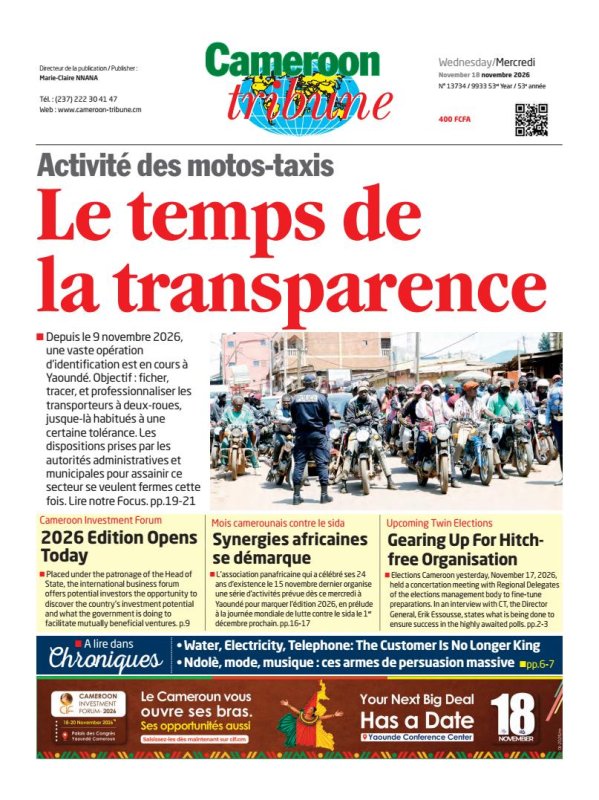
Water, Electricity, Telephone: The Customer Is No Longer King
- Par Eldickson Agbortogo
- 18 Nov 2026 07:25
- Likes
D oes the capitalist dictum that “the customer is king” still hold true today? In yesteryears, any debate over this question could have been easily dismissed, as basic services such as water, electricity and telephone were relatively accessible. Today, however, the reality is quite different. Service providers appear to be gradually losing sight of their primary responsibility: satisfying their customers. In several villages, towns and cities across Ca meroon, access to water, electricity and reliable telephone services has become as scarce as hen's teeth. Some com munities go for days, weeks and even months without these essential services. Is it because consumers have failed to pay their bills? Not necessarily. Rather, the situation raises serious questions about the priorities of companies entrusted with providing these services and whether their pursuit of profit has overshadowed their obligation to serve the public. When one considers the billions of FCFA reportedly generated by some of these companies annually, alongside the attractive remuneration packages enjoyed by their employees, it is enough to ag gravate the stress of many consumers. Take electricity, for instance. How can a country endowed with several hydroelectric dams and numerous waterfalls continue to experience persistent power shortages? In many neighbou rhoods across Cameroon, electricity cuts have become so commonplace that people almost pray for the lights to remain on while ironing their clothes, watching television or studying. Business operators are equally affected. Shop owners and traders fear that power interruptions will spoil their refrigerated fish, meat and other perishable goods. In some barbershops, customers have had to leave with half- finished haircuts because of sudden electricity cuts. For years, the electricity sector has undergone major institutional changes. The transition from the State-owned SONEL to the privately operated AES-SONEL, and subsequently to ENEO, raised expectations of improved service delivery. The change of ownership and rebranding were expected to usher in a new era of efficiency and reliability. Unfortu nately, many consumers are still waiting for the promised transformation especially with the coming of SOCADEL. A similar situation has characterised water distribution, which moved from SNEC to the Cameroon Water Utilities Corporation (CAMWATER). Consumers often find themselves stranded in the middle of unfinished domestic activities because taps have suddenly run dry. For years, many hou seholds do pay bills for meter maintenance without a drop of water. The familiar complaints, “They have cut the lights” and “So there is no water”, have become part of everyday conversations. People speculate about the causes of the interruptions and wonder when water will return. In their frustration, some don’t only direct insults and curses at the utility companies’ workers, but even chase them away. Such reactions reveal the depth of public dissatis faction especially in situations where they monopolise the powers to connect and disconnect, supply and withhold these essential services at will. If nothing is done, it gives the impression that consumers are entirely at the mercy of the companies responsible for serving them. For telecommunications, something is fundamentally wrong, and it is time those responsible to be held accountable for their failure to introduce meaningful improvements. Managers cannot continue to operate with outdated equipment in definitely while claiming to possess the expertise and qualifications required to modernise the sectors under their supervision. In a sector that is expanding at lightning speed and billions of profits being channelled to foreign accounts by the mobile telephone companies, it is a pity that majority of the consumers can’t make hitch-free calls because of no fluid network. How can one explain that in an era of new technology boom, it is practically impossible especially at the centre of big towns for one to make a call to a person just besides? From morning to evening, it is common to hear, “the number you call is not available please call later». Each of these failed attempts does not only deduct data, but also precious time wasted and busi nesses retarded. How long must consumers c...
Cet article complet est réservé aux abonnés
Déjà abonné ? Identifiez-vous >
Accédez en illimité à Cameroon Tribune Digital à partir de 26250 FCFA
Je M'abonne1 minute suffit pour vous abonner à Cameroon Tribune Digital !
- Votre numéro spécial cameroon-tribune en version numérique
- Des encarts
- Des appels d'offres exclusives
- D'avant-première (accès 24h avant la publication)
- Des éditions consultables sur tous supports (smartphone, tablettes, PC)







Commentaires