

Dr. Akinwumi Ayodeji Adesina: “We Are Going To Be Investing More In The Energy Sector”
- Par Virginie ONANA
- 19 Jul 2017 16:45
- 0 Likes
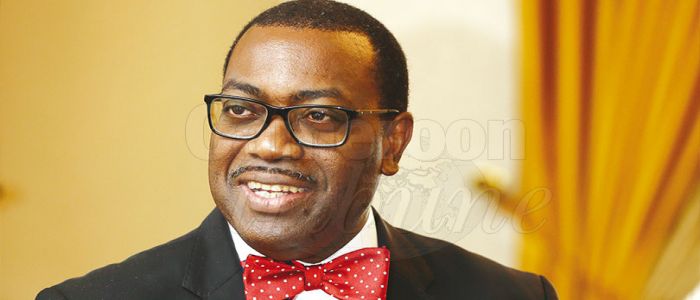
President of the African Development Bank Group (AfDB).
What general overview do you have of the African Development Bank Group (AfDB) since you took office?
First and foremost, it is a great honour to be President of the African Development Bank. But for me as President of the African Development Bank, it is not a job. I don’t have a job. I am on a mission; a mission for fast-paced transformation of Africa. I think that Africa is behind in so many areas and so we have to really work to make sure we catch up and move faster. That is why when I became President of the African Development Bank, the first thing I did was to set up what we call the Hi5 of the bank which is to light up and power Africa and industrialize the continent, integrate Africa and improve the lives of people on the continent. Just like you know, generally for the African Development Bank, for us to develop a strategy – one strategy – and get it approved by the board, it takes us about two years. But we got four of the five Hi5 strategies developed and approved by the board in less than five months. It tells you of the speed at which things are happening. Some of the things which have happened in the last few years is that the banks have been at its best. We had our highest approval in the history of the bank of 10.5 billion US dollars. If you look at it in terms of our disbursements, we did 6.5 billion US dollars, again the highest in the history of the bank. The bank was able to raise 10.5 billion US dollars on the international capital market to finance its operations – again the highest in the history of the bank. We saw 48 per cent increase in the income of the bank in the last one year alone. And if you take a look at what has happened in terms of how we supported some countries, we did last year, for example, syndications. We were able to put together what we call syndicated AB loan 965 million US dollars which was for ESKOM in South Africa to be able to do power. That is to allow it to do about 8,000 megawatts of power rehabilitation and to also construct additional 13,000 megawatts of power. Again, in terms of mass indication, it’s the highest in the history of Africa.
So the President of AfDB is a man of records!
Well, it is what I just told you. We are on a fast pace for the bank. We maintain our triple A rating as a bank. We are in a very very difficult global environment. We were able to raise a lot more money for the continent. For example, just a week ago, I was able to sign with the Prime Minister of Japan an accord where Japan provided six billion US dollars of financing for energy for Africa in collaboration with the African Development Bank. So we are also reforming the bank in terms of how we work. We decentralised the bank into five regions; one for West Africa, one for East Africa, one for Central Africa and others for North and Southern Africa. The reason is this, I like sports. When you look at soccer (football), there is no way you can score if you are constantly on your side. So you can’t be at the headquarters and hope to score development goals. You have to be closer to the clients, closer to the private sector and closer to the country. That is what we are doing. We are making ourselves a much efficient bank, a much impact-driven bank but a bank in a hurry for Africa’s development.
In essence, you are talking much about electricity. How far have you gone with the implementation of the revolutionary model of the bank?
When I took over, I said we were going to do energy. The first thing we did was to roll out what we call the New Deal for Energy for Africa which means for me it makes no sense at all, that 138 years after Thomas Edison developed the light bulb, Africa is struggling to light it. It is a shameful thing. And my own approach to development is that if you are not ashamed of something, you will not change it. So we decided that as a bank, we are going to put in 12 billion US dollars just into the energy sector in five years alone. We are going to use that to leverage between 45 and 50 billion US dollars in the power sector. I just explained to you that just last year, the Prime Minister of Japan, during TICAD in Nairobi, nine Heads of State and myself met him and told him that we need base load power to do industrialization of Africa. I went to see him in October last year and less than two weeks ago, we signed a six billion US dollar facility with Japan for Africa. It is a game changer for Africa. The third thing we did was that we had to restructure ourselves to be fit for purpose to help Africa deliver on power. We created a new vice presidency just for power. This means we are the first and only multilateral development bank to do that. I know that if you are not structured for purpose, you can’t deliver. We have a new vice presidency that is driving our work on power. We have a lot of water, sunshine, geo-thermal capacity. Those are all potentials. No body eats it. We have to unlock it. So, we had set up a fund, just some couple of months ago called Facility for Energy Inclusion. It is a 500 million US dollar fund. It is supposed to help private entities that are going into renewable energy – whether it is hydro or solar, but they are working in anything below 30 megawatts capacity for smaller businesses that are in the area of renewable energy. We have also launched an Off Grid Revolution Plan for Africa where we will be supporting businesses to do solar at scale across African countries. The other thing we have done for the energy sector is that the African Development Bank is now hosting what is called the African Renewal Energy Initiative which is the biggest initiative to come out of COP21 in Paris. And this has a commitment towards it of 10 billion US dollars from G 7 countries. So we have been very busy in making sure that we are restructuring ourselves, creating the right type of funds and also pushing things. But let me state concretely what we have been doing in the domain of energy in the last one year. In the last one year, in 2016, 3.3 million Africans benefited from our investments in access to electricity. We invested about 1.7 billion US dollars last year in the power sector and we leveraged 2.5 billion US dollars in it. So, you can see there are a lot of things we are doing because I believe that you cannot develop in the dark. You just can’t.
Mr President, we understand that Cameroon has had relations with the AfDB for the last 45 years. What is your appraisal of Cameroon’s performance since you took office?
First and foremost, Cameroon is a very important country to us. Even if you marry for 45 years, you will be celebrating. So we have been together in this development marriage with Cameroon for the past 45 years. It has been a great marriage because over that period we have funded well over 100 projects for a total of about 2.5 billion US dollars. More recently, our current portfolio in Cameroon stands at 22 projects for a total of 1.4 billion US dollars. Much of that is in the area of transport. Right now in Cameroon, we are the largest financier of transport and telecommunications. That sector alone accounts for 61 per cent of our investments. Just to give you an idea. We are financing the road linking Yaounde to Bafoussam, to Bamenda and right away to Enugu. We are funding the study for the railway that will link Chad to Cameroon. Also, we are supporting the development of the interconnection for power between Chad and Cameroon. There is an area we are investing in this year, which is the River Logone. We are trying to build a bridge there to facilitate trade between Cameroon and Chad. We have a very important project on agriculture; to develop value chain in agriculture. We also have a lot of things we are doing in the area of water and sanitation. Let me say that, in agriculture, as I discussed with President Biya today (Monday July 17, 2017) that this country has a huge potential for agriculture. It is a country where the soils are so good. If you throw up anything like a seed, before it hits the ground, it can grow. That is how good it is. But I think that Cameroon has to unlock its potential in agriculture by making it a business. Whether it is in terms of cotton, cocoa, forest product, banana or plantain, Cameroon should not be at the bottom. It should do agro-industrialization; processing and adding value to its product. This will help the country to stabilise in terms of macroeconomic stability. This will make the country not to be importing food and it is already loosing so much of what it is producing already. Agro-industrialisation will allow for the changing of the rural economy of Cameroon and create a lot of businesses in rural areas and very good busine...
Cet article complet est réservé aux abonnés
Déjà abonné ? Identifiez-vous >
Accédez en illimité à Cameroon Tribune Digital à partir de 26250 FCFA
Je M'abonne1 minute suffit pour vous abonner à Cameroon Tribune Digital !
- Votre numéro spécial cameroon-tribune en version numérique
- Des encarts
- Des appels d'offres exclusives
- D'avant-première (accès 24h avant la publication)
- Des éditions consultables sur tous supports (smartphone, tablettes, PC)


Reactions
De la meme catégorie

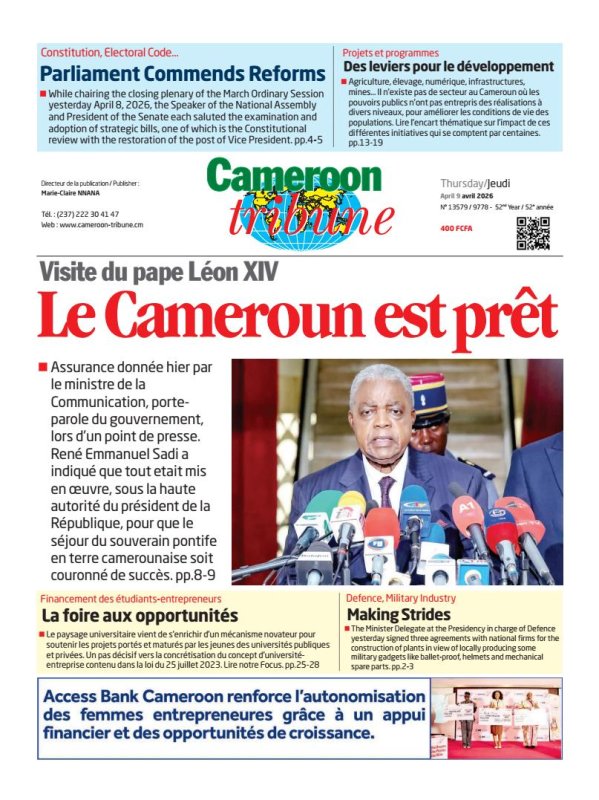
Visite du pape Léon XIV: Le Cameroun est prêt
- 09 Apr 2026 14:12
- 0 likes
Effective State Functioning: Senate Welcomes Constitutional Reforms
- 09 Apr 2026 14:03
- 0 likes


Commentaires