

From Trash To Treasure: Architecture Graduates Propose Circular Economy Blueprint
- Par Kimeng Hilton
- 27 Aug 2026 15:45
- 0 Likes
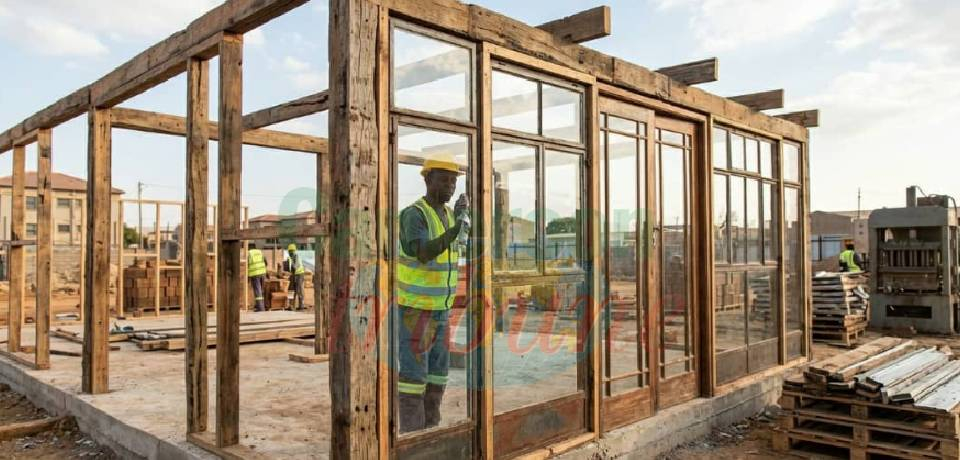
The alumni of the Institute of Fine Arts, Foumban, of the University of Dschang, have a made submission on processing waste into various construction material.
As Cameroon’s major urban centers groan under an unprecedented waste management emergency, an association of forward-thinking young architects and graduates from the Institute of Fine Arts, IBAF Foumban of the University of Dschang, has stepped forward with a radical shift in perspective. Rather than viewing the mounting refuse choking street corners as an intractable sanitation burden, they propose treating it as a vital, unexploited supply chain for sustainable building construction.
Concrete Pathways
The movement took center stage on August 1, 2026, when the association hosted a high-level live professional session. The dialogue brought together emerging design professionals to chart concrete pathways for transforming municipal waste. Ranging from plastics and demolition rubble to glass and composite cardboard - into standardized, load-bearing, and insulating architectural materials.
The Leaders
The leadership driving this initiative includes Tagne Henri Josue (Intern Architect), President; Boniak Balehen Arthur (Intern Architect), Secretary; Nkeng Nyemeck Benjamin Yan (Intern Architect), Planning Officer; Minkoa Nga Paul Andy (Intern Architect), External Relations Officer. And Tchinda Sezono Zidan (Intern Architect), the Communications Officer and author of the session's comprehensive report.
Not Isolated Hygiene Issue
Together, the association argues that Cameroon’s urban development can no longer afford to treat waste management as an isolated hygiene issue. It must be integrated directly into the material fabric of the nation’s architecture.
Decades-Long Gridlock
Cameroon’s major cities - Douala, Yaoundé, and Bafoussam - are expanding rapidly under demographic pressure, suburban sprawl, and intensified commercial activity. Historically, baseline national generation figures revealed daily municipal outputs of $0.88 kg/capita/day in Douala, $0.85 kg/capita/day in Yaoundé, and $0.57 kg/capita/day in Bafoussam. With official collection coverage historically hovering between a fragile 15% and 40%, an estimated 60% to 85% of generated refuse has remained trapped inside residential neighborhoods, the architects say.
Daily Structural Deficit
In Douala alone, where daily waste output exceeds 2,000 tons, contract capabilities cap out at roughly 1,500 tons per day. Leaving a structural daily deficit of 500 tons accumulating in street drains, low-lying zones, and informal black spots. A recent urban governance survey in Yaounde mapped 264 waste sites, discovering that 58.33% were illegal, informal dumps.
Past Efforts
Over the decades, state authorities and private entities have launched repeated initiatives to stem the tide, yet sustainable solutions remain elusive.
Hysacam (Société d'Hygiène et Salubrité du Cameroun): Founded in 1969, the primary private operator collects over 1.5 million tons of waste annually across 17 cities. However, the service relies up to 90% on municipal funding, routinely exposing operations to public payment delays and severe cash-flow bottlenecks.
Transfer Centers and RPU: Strategic attempts to modernize operations include the inauguration of Douala’s 1 billion FCFA, 5,000 m² Youpwè Transfer Center in September 2024. To funnel waste to the Ngombé landfill, complemented by the creation of the Urban Cleanliness Board (Régie de la Propreté Urbaine - RPU) in July 2023.
Energy Valorization Proposals
Government plans have repeatedly targeted waste-to-energy conversion, including announced biogas plant projects totaling 72 MW across Yaoundé, Douala, and Bafoussam. As well as an ambitious 856 billion FCFA waste-to-energy framework announced for Douala and Yaoundé.
National Waste Exchange: The persistent gap between policy and field execution has kept sustainable waste management out of reach. Over the years, environmental analysts and journalists have documented structural blueprints designed to commercialize waste streams. And establish viable industrial exchanges. Despite these interventions, administrative delays, tax disincentives, and a lack of structured downstream buyers mean these proposals have yet to yield their intended fruit.
Even progressive municipal efforts, such as the City Council of Bafoussam’s initiative establishing a 60 FCFA per kilogram buy-back rate for plastic waste, struggle to scale without a direct, heavy-volume industrial off-taker.
Circular Economy Meets Architecture
It is precisely at this missing link - the gap between collected raw waste and guaranteed industrial end-uses - where President Tagne Henri Josue, Communications Officer Tchinda Sezono Zidan, and their colleagues at IBAF step in.
Tiny Fraction Recycled
In his detailed synthesis of the conference, Tchinda Sezono Zidan notes that of the nearly 600,000 tons of plastic waste Cameroon generates annually (accounting for roughly 10% of total municipal waste), only a tiny fraction is recycled. The IBAF association contends that the construction sector possesses the volume capacity needed to absorb these vast waste streams.
The architects outlined technical pathways for converting waste into certified, high-performance building components:
Reinforced Compressed Earth Blocks (CEBs): Incorporating processed plant fibers and industrial organic residues into earth blocks to dramatically enhance tensile and compressive strength while reducing cement dependency.
Upcycled Polymer and Composite Insulation: Transforming shredded cardboard, beverage cartons (Tetra Pak), and recycled plastic foams into modular acoustic and thermal insulation panels engineered specifically for tropical humidity control.
Building Component Re-Use: Systematically harvesting structural steel frames, timber joinery, ceramic tiles, and crushed masonry rubble from demolition sites to feed urban renovation projects.
Glass and Plastic Aggregate Concrete: Utilizing washed, sorted, and ground plastic aggregates or crushed glass to substitute natural sand and gravel in non-structural masonry units, paving blocks, and interior partitions.
Role Of Architect
The IBAF leadership stressed that implementing alternative waste-derived construction materials requires strict scientific standardization rather than ad-hoc assembly. As detailed in the session report compiled by Tchinda Zidan, the association lays out three imperative mandates for technical safety:
Rigorous Material Characterization: Raw recyclates must undergo strict mechanical testing, chemical inertia verification, and long-term weather durability assessments under intense tropical UV exposure and humidity.
National Standardization (NC Benchmarks):
Cet article complet est réservé aux abonnés
Déjà abonné ? Identifiez-vous >
Accédez en illimité à Cameroon Tribune Digital à partir de 26250 FCFA
Je M'abonne1 minute suffit pour vous abonner à Cameroon Tribune Digital !

- Votre numéro spécial cameroon-tribune en version numérique
- Des encarts
- Des appels d'offres exclusives
- D'avant-première (accès 24h avant la publication)
- Des éditions consultables sur tous supports (smartphone, tablettes, PC)








Commentaires